Showing posts with label writing. Show all posts

Sunday, 3 July 2022

A Novel Point of View?

Schools in Argyll and Bute finished for the summer holidays yesterday, so at one o’clock I found myself singing my annual rendition of Alice Cooper’s Schools Out for Summer, although with a little less enthusiasm than I perhaps used to when I was a classroom teacher. At least I have six weeks ahead of me without an alarm going off at seven in the morning even if I do have to entertain my kids more often!

sunset on a loch. sky in shades of orange and yellow. woman in pink sea-kayak in middle ground on calm water.


As soon as the girls were home, they wanted to go to the beach and, as it was too choppy for the paddle boards, they went swimming while I took my kayak out. After a rather dodgy attempt to get into it, I finally managed without either capsizing or being washed up onto the beach. I did, however, discover that my plan to paddle leisurely up and down the shoreline was simply not going to happen. The waves were high enough that the safest option was to head directly into them at ninety degrees, then turn as quickly as possible and head back to shore the same way. (The photos were taken on better days!)

a sunny day looking onto the shore of Loch Long. The water is pale blue and a rolling hill is in the distance.
This meant that I found myself further out into the sea-loch than I usually go, giving me a different perspective of the peninsula I live on. This idea of looking at the place I am so familiar with from a different point of view (a novel point of view?) has always been intriguing to me. It was when I discovered that there had been a Viking fort on the site of a friend’s house, and human remains found in my parent’s garden (in Victorian times — thankfully I didn’t have to even consider the possibility of Mum having buried someone under the patio — maybe I'll save that idea for a future book…) that I thought about setting a Viking series here.

a sunny day looking onto the shore of Loch Long. The water is pale blue and a rolling hill is in the distance.

So little is known about the ancient kingdom of Strathclyde that it doesn
’t often feature in novels and it’s divided from modern Scotland by language — they most likely spoke Brythonic or Cumbric, a language closer to modern Welsh than modern Gaelic — but nevertheless, there are remnants throughout the area of links with the Norsemen if you know where to look. (Knockderry, Luss, Carrick Golf Course, Dumbarton Rock and Govan, to name but a few.) These remnants may not add up (yet) to a significant relationship between the two peoples, so I have kept these interactions minimal in my novels, but there are enough to suggest that there was definitely some level of significant contact.
A sunny day looking onto the shore of Loch Long. The water is pale blue and a rolling hill is in the distance.


It’s not until you are actually out there on the loch that you see the water as forming a connection, rather than it being a division. Places that are far distant by road suddenly become the closest town. People that you would be unlikely to meet on land suddenly become the very people you are most likely to bump into. The long fingers of the peninsulas that form the northern banks of the Firth of Clyde suddenly become accessible to one another, rather than separated by hundreds of miles of long, narrow, winding roads.
An expansse of calm blue water with a sliver of dark land just above the mid-point. A single white sailed yacht sits in the centre.

Perhaps this is something writers always do — distance themselves from places and people and perhaps even themselves — so that they can tell these other stories, but I think, for me, anyway, that it’s more pronounced when writing historical fiction. Looking back at the landscape in front of me from far out on the water, I imagined what it would have looked like then. There would, of course, have been the same basic bare bones of the landscape, but what areas would have been attractive to live on? Where had the best access to the sea-loch and streams? Where is the flattest land for building? What would those buildings look like? Sadly, my artistic skills don’t extend to me drawing an image, so I have to use words and hope that readers can picture it roughly the way I have — or maybe that doesn’t matter? Maybe it’s okay for them to picture it their own way?

a viking man embrcing a woman with long dark hair in a flowing white dress. the bottom of the cover shows a snow-covered landscape.

Our new schedule for the Novel Points of View blog has meant that, rather serendipitously, I have ended up being the one to blog the weekend prior to the release of book three of my series. The Viking’s Princess Bride will be released on Tuesday July 5th. Thanks to various delays, it’s not particularly seasonal as it’s set at Imbolc in early February and features the two main characters snowbound in a shieling high on the moors. Shielings were dwelling houses used primarily by women during the summer when they took the sheep up onto the moors to give them access to richer grasslands. This is Scotland, however, so I’m not going to jinx our summer weather by saying that the presence of snow indicates that the events couldn’t happen in July!

I hope everyone has a lovely summer and sees the sun at least once or twice!

Mairibeth

Sunday, 24 April 2022

How to Herd Cats (Or Attempts to Organise My Life)


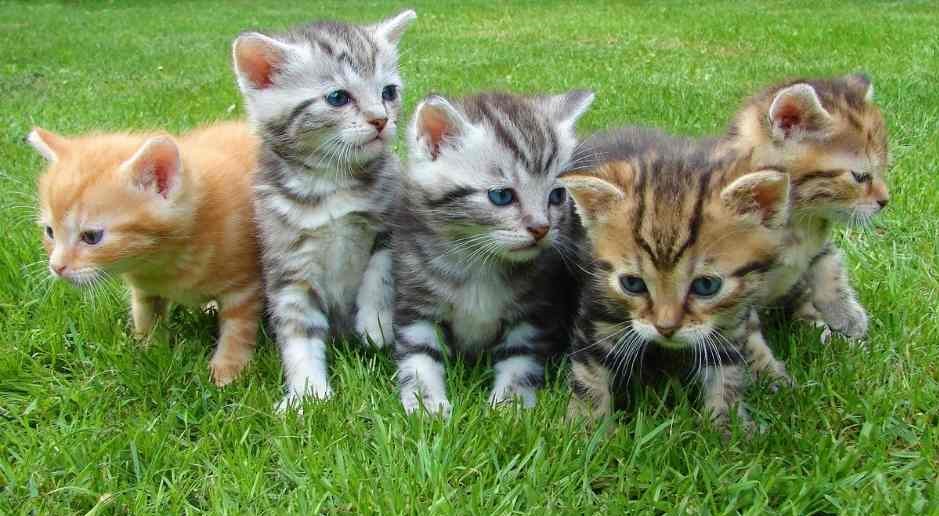
Five kittens looking like they are all about to run away in five different directions

I often feel that my life is a chaotic mess. I rarely get one activity finished, before another one pulls my attention away from it and I end up with a very long to-do list that I can’t actually tick any items off because, although I have accomplished many tasks, I haven’t actually completed any of them in full. After messaging Rae the other day and finding she was having similar issues, and, working on the principle that sometimes we understand a process better when we try to teach it to others, I decided to share my current attempts at organising my writing life with you.

A messy bundle of colourful electrical wires
Getting organised feels to me like I’m trying to herd cats — there are lots of things independently wandering about and none of them ever stays where they are put. Most of my ‘cats’ are justifiable activities: I have a novel to finish editing, another one to write, regular short stories with deadlines to submit, a teaching job, housework, an elderly father in a care home, two children at home, a third child living ‘independently,’ and a husband who spends much of the year at sea — where he gets to focus on his job with no other distractions… Hmm.


The list goes on, as I’m sure it does for all of us. And while I am the sort of person who can easily leave the housework undone with few regrets, I also see other people managing to accomplish more than I do despite having just as many cats (if not more) in need of herding.

Cover of the book The Organised Writer by Anthony Johnston
Earlier this year, I bought a book called The Organised Writer by Anthony Johnston and read it cover to cover. Anyone familiar with my reading habits (apologies to Carol MacLean for reading Jeannie’s War entirely out of order) knows that this is, in itself, a rarity. While it contained many helpful suggestions, and I would recommend it, I’m well aware that my brain simply doesn’t function the way Johnston’s brain does and while I’m currently working on untangling the mess that constitutes my thought patterns until I do, I will have to compromise with some of his guidance. 

So, what I am doing? Well, I have developed a four-pronged approach. I thought of a rather sweary title for it but then decided to call it the Fork Handles Approach. This will hopefully light my way to a more organised writing life. (Note: this joke doesn’t work as well in written form.)

Four lit candles in diagonal line
Cover of To Do list. Gold on pink background saying I am very busy.

The Fork Handles Approach

The To Do List: Write every task that needs done on this. Every task. (And yes, I have been known to write a task I’ve already completed down just so that I can tick something off — but I think this is okay — the more ticks I see, the more likely I am to believe finishing things is possible.)

Front cover of academic year diary in pink/purple swirl pattern saying Monday Mojo
The Week to View Diary: Every item on the To Do list then needs to find a place in the Diary. This sits beside me at all times so that I can regularly check what I’m supposed to be doing. I then force myself to do that thing first. Before I do any thing else. (This may sound obvious but believe me, it is the most difficult stage in the process for me!) I then get the satisfaction of ticking it off, both on my To Do list and in my Diary, thereby making me feel twice as productive! 

Cover of project planner showing multiple post it notes attached to a wall in bright coloursThe Project Planner: While the To Do list/Diary combo works for most things, there were some troublesome items on my to do list, that just never seemed to leave — those bigger items that take more time, or that are actually the result of a series/combination of tasks. In order to deal with those I’ve started to use a Project Planner. I couldn’t find one that did exactly what I wanted it to do, so I used what I’ve learned from Canva and KDP and designed my own. (Some of you may recognise this as a procrastination technique, but it was fun and necessary and that’s the story I am sticking to!) I have actually sold a few copies of this and the new author name I picked for this project makes me smile. (This is also a bit sweary, so don’t click on the link in the comments if you’re easily offended.) Each bigger project gets its own page and can then be further broken down into smaller pieces. What I call Tiny Achievable Targets. I then still feel like I’ve accomplished something when I tick one of those off!

Picture of magnetic wipe clean habit tracker with orange pen. Lines for Words, exercise, tidying and studying filled in with varying degrees of success.
The Habit Tracker: I use this for all the never-ending items on my To Do list. Things like learn ten new vocabulary words every day, or exercise daily, or even — dare I say it — housework. How do you ever manage to tick those items off a To Do list successfully? I now have a wipe clean Habit Tracker right in front of me as I’m working each day. (I’m clearly still a work in progress when it comes to developing habits, but I am definitely improving.) 

Between all of these, I appear to be making some progress (my editor, if she’s reading this, will be rolling her eyes!) On the positive side, however, I have submitted competition entries more regularly this year, my writing is more consistent, and one day… someday… hopefully soon, I will finish The Viking's Princess Bride and publish it! 

Now, to learn how to focus on one writing project at a time. Wish me luck!

The Organised Writer

My Project Planner

Jeannie’s War

Saturday, 16 April 2022

When it's time for Time Out

Writers find it difficult to switch off from their latest novel sometimes. They are either thinking up new stories, thinking about how to write them, thinking about their first/second/ gazillion(th) draft, thinking about edits, thinking about manuscript submissions, thinking about their failings, thinking about their successes, thinking about promotion, thinking about the next story.... well you get the picture. So it is always a good idea to cleanse the brain and do something completely different.

I joined InTune Choir just before lockdown and, despite covid restrictions, I am still a member! Research shows that singing can relieve stress, boost the immune system and may improve snoring and lung function. It is also believed to improve memory, mental health and develop social connection. All these benefits help make it the perfect hobby to not think about writing. The video below is the InTune Choir at the Minack Theatre in 2016. I am delighted to say that we will be appearing at the Minack Theatre again on 7th May, 2022. Money raised will go to the Cornwall Air Ambulance.


So let's see what hobbies or guilty pleasures other writers have to take their minds off story telling. First up is award winning short story and flash fiction writer, Rae Cowie.

"Remember when most folks bought an actual daily newspaper, with pages that rustle? Then 24-hour rolling news stations popped up and articles became available for free online – and newspaper sales slumped. But, for me, nothing beats sitting with a cup of tea, flicking through the daily news.

Here in north-east Scotland, we have the Press and Journal (also known as the P & J), which is full of local and human-interest stories, perfect when I’m stuck for inspiration. I rip out articles and headlines that grab my attention and stick them in a ring binder, waiting for the day when I’ll riffle through them and invariably notice themes – protection of wildcats, plastic in the ocean, foodie stories etc.

But I’m not the only fan of the P & J, it is also enjoyed by royalty, delivered to Balmoral Castle when the Queen arrives for her summer break."

Press and Journal logo

Mairibeth MacMillan, author of the Brothers of Thunder, an historical Viking romance series, prefers her 'time out' to be outdoors.

"During the last few years, I’ve taken up wild-swimming. Now that I have the basic gear, it’s essentially free as I live near a sea-loch and can simply wander down to the beach. The water is baltic (as we say here on the west coast of Scotland), I rarely swim unless covered neck-to-toe in black neoprene and the sun rarely shines, but swimming outdoors with no restrictions is both a physical and spiritual experience. For a while, all my cares and worries wash away and I feel that if I could just swim far enough, I’d reach another world!

Mairibeth at her local sea-loch

Jenni Keer, who has several successful commercial fiction novels under her belt, prefers to burn extra calories with friends to music.

"I’ve been attending a dance class for the last twelve years, which not only combats the writer’s bottom but is also is an invaluable headspace for me. (Sometimes it’s hard to switch off from your WIP when you’re an author.) We have a gold level formation disco team and I’ve achieved bronze in my freestyle solo. The ladies I dance with are some of my closest friends and biggest supporters."

Our dance class was  a guest Morris dancer!
Our dance class was 
recently visited by a Morris dancer!

John Jackson
, author of historical romances based on his ancestors, prefers indulging in something that embraces all the senses.

"For me, its food! That includes, of course, the activities that go WITH food; i.e. cooking, eating and drinking!

I do almost all the cooking at home now, and I cook a lot of food from all over Asia. Friday night is Thali night in our house. The objects on the thali could be anywhere from the Pacific through South East Asia to the Indian subcontinent and beyond. So many recipes, so little time!

Or, as Lionel Bart put it in Oliver! “Food, Glorious Food! There’s nothing quite like it!”"


It's been great fun learning about how my writing friends take their minds off writing. I hope it inspires you to take some time out to recharge your batteries and 'cleanse the mind'!  If you already have a method, do let us know in the comments, we would love to hear about it!


Saturday, 5 March 2022

Reading the Signs

Two weeks ago, I attended my first live Book Festival workshop in over two years. And appropriately enough it took place in my hometown of Paisley — a place I left over twenty years ago and until four years ago had made a point of returning to as little as possible. But things are changing. The town itself is changing and I know that I have changed too. 

 The weather that week had been terrible and we’d lurched our way from one storm to another. But when I arrived in Paisley it was calm, clear and almost sunny. Part of me felt guilty for going — I have had third round edits of The Viking’s Princess Bride hanging over me, undone, for weeks now — but I’m glad I went for several reasons.

Firstly, I had arranged to meet another writer and it was good to see her – we also befriended another woman, a former journalist turned museum curator, who patiently listened to the two of us wittering on nostalgically. Secondly, I ran into another friend quite by chance. He’s a musician and as it turned out my workshop took place above the hall where he was playing in so I got to hear him too!

Thirdly, and perhaps most importantly, it let me reset my thinking about writing, taking me back to a point at which ideas are everything, a series of unconnected words and ideas just waiting to be formed and full of infinite potential. This is the part of writing I enjoy the most and it was good to take a break from editing and experience a reminder of that more joyful part of the writing process.

The workshop was entitled Walking With Words: Oot and Aboot in PaisleyThe workshop itself focused on the idea that there are words all around us and that as writers we can find these and use them in unexpected and interesting ways. Observing the world around us and seeking out the words from our environment, especially those we might otherwise not notice due to their familiarity or their ordinariness is an interesting exercise. 

Stairs marked with observe social distancing reminder

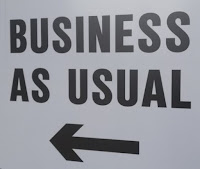
Business as usual sign with arrow pointing to the left

As a writer I have often been advised to ask what if when working out story ideas, but during this workshop I found myself perhaps at the step before that one and asking why?

Why are those words there?

The name Paisley is probably more familiar to people due to the pattern which was commercialised in the town’s extensive textile industry from the mid-eighteenth century to the late twentieth. There are obviously a whole range of issues surrounding the history of this textile industry and the design of this pattern, that could be explored in various types of writing. After the mills closed the town entered a period of decline which it is only now beginning to pull itself out of and many of the signs we found related to either the textile industry or the idea of regeneration – particularly appropriate for a writer currently teetering on the brink of burnout.

Shop sign: A Gathering Thread

Sign reading: When the day's work was over they issued in a stream, their hands and arms marked with all the colours of the rainbow and they made the streets lively on their way home.

Many of the street names reflect the textile industry and many of the town’s significant buildings were funded and named after the two biggest mill-owning families. Paisley has one of the highest concentrations of listed buildings per square mile of any town in Scotland. Many of these buildings are currently undergoing renovation work and so many of the words we found related to that.


Sign showing various Paisley street signs: Incle, Cotton, Silk, Lawn, Gauze, and Thread Streets, Dyer's Wynd

We chose to stay in our group of three when we were sent out on our walk. Even in our wee group of three, we all passed the same signs and buildings but all made quite different choices about the words we chose to ‘keep.’  Some of the shop and pub names appealed to me as possible titles!
The Cave

Scoopalicious

Sometimes as a short story writer, I worry that I'll run out of ideas. After this workshop, however, I’m feeling reassured. There’s potential all around us if we just look for it. Tilt your head to one side and change your perspective. Look at the familiar things around you and start to see them as something new. 

Pub Sign: The Northern Way

Nightclub sign: Fantoosh

Our walk lasted around an hour and sitting down to write this post has made me realise just how much potential I noted down in that short space of time. The next time I’m looking for an idea I’ll go back to these photos and look at these words. Then I might think about what might have happened in those places for those words to end up there. I might research the historical events or invent a narrative of my own. I might use a phrase as a prompt or as a title. The possibilities are endless if I only read the signs! 

Statue showing small child holding a doll set in a teardrop shpaed flower bed.


Three words remain with me after the workshop, pushing me forward through my edits - although I managed not to photograph one of them!

Reimagine. Reawaken. Restore.


Saturday, 27 November 2021

Road Trips for Writing Inspiration


I did some road tripping this autumn!


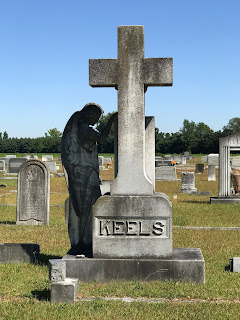
In September I made my first ever trip to Murrell’s Inlet, South Carolina. Perfect timing, as the summer crush was over,  the weather was warm, and the beach was stunning. This trip was actually a writing retreat, and although I didn’t force myself to be productive all day long, I did make some plans and work on the outline of the book that I’m going to start writing in January. Although the “getting there” was just what I needed (Don’t all writers need beach time?), this trip was all about the journey. I drove, by myself, and took my time stopping at historic cemeteries for a few photos. 


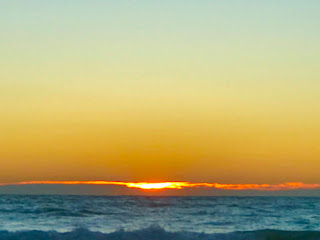
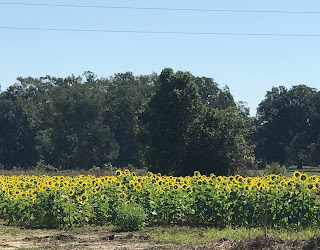
When I passed a field of sunflowers in bloom, I turned around and went back specifically to snap a few photos. The house where I stayed was right across the street from the beach, so early morning sunrises provided the perfect beginning to each day.


October found me in Natchez, Mississippi. Founded in 1716, Natchez has been on my bucket list since I relocated to the southern United States. Although the community that thrived when cotton was king has changed a bit, Natchez boasts a bounty of gorgeous antebellum homes, many of them converted to Inns and B&B’s. We stayed at The Guesthouse, an antebellum home built in 1840 with lovely rooms full of period appropriate furniture and lots of atmosphere. The Guesthouse also has its own ghost in residence, namely a young boy named Shannon, whose post-mortem painting hangs in the bar.  Shannon allegedly roams the halls, playing with his toys. Natchez is the home of many a ghost tour and is known for its historic cemetery, which is full of amazing stone and iron work. We wiled away the hours walking along through the various family monuments, conjuring up ghost stories of our own.  


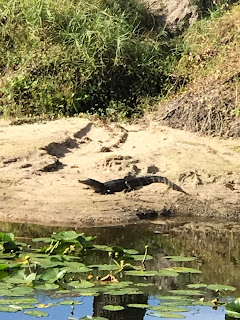
And finally, the hubs and I travelled to Florida for a last trip to the beach. No cemeteries on this trip. Lots of beach time and the occasional mojito. A good time was had by all, as evidenced by the pictures. And, yes, that really is a baby alligator.


While my trips didn’t add to my word count, they definitely went a long way towards refilling my creative well. And as I sit here writing this blog entry, I can say with certainty that I’m itching to start writing. But I’m going to make myself wait until January, just to make sure I’m truly rested. Plus, there may be other road trips in my future!

How about you? Do you travel for inspiration?


Thursday, 28 October 2021

Walking in their Footsteps

 I visited the Lake District in September. The natural beauty of the landscape is breathtaking, very inspirational and well worth a visit. While I was there I visited Hill Top, Beatrix Potter's most famous home. The 17th century farm cottage was gifted to the National Trust by Beatrix upon her death with the expressed wish that it should not become a museum, but be preserved in the condition of how it looked when she lived there. Her furniture, including her writing desk, are on display and it is easy to imagine Beatrix walking through the rooms and writing her children's books. Several parts of the cottage, including the oven range, inspired Beatrix's illustrations and can be easily recognised in her tales. She wrote many books, initially unaware of the success they would become...

“I am aware these little books don't last long even if they are a success."

Beatrix Potter

Beatrix Potter's home, Hill Top

Beatrix Potter's home isn't the first writer's home I have visited. That accolade goes to William Shakespeare's birth place in Stratford-Upon-Avon. William was the third of eight children and was born in 1564. Following his marriage to Anne Hathaway in 1582, he continued to live in the house with his parents. When his father, John Shakespeare, died in 1601 William inherited the house and leased it out. The start of William Shakespeare's career is unclear, but what is known is that by 1592 he had an established reputation in London and would go on to be the world's greatest playwright and poet. Although the house appears substantial for the time (his father worked as a glove-maker and held important civic positions in the town), the rooms are small and it would have been quite crowded with so many children and, in later years, two families living there. Once again, it was easy to imagine William spending his formative years in the house, chasing his dream of becoming a play-write and eventually fulfilling it.

William Shakespeare's birth place

Of course, not all stories have such a happy ending. Anne Frank's Diary was written during a time of terror and it's author, a young Jewish girl forced into hiding during the rise of the Nazi Party, never lived to see it published. She used the diary as a way to escape the oppressive ordeal which lasted years. As Anne said in her diary...

"The brightest spot of all is that at least I can write down my thoughts and feelings,
otherwise I would be absolutely stifled."
Anne Frank

 I visited the secret annex in Amsterdam several years ago. Anne, her family, the Van Pels family and Fritz Pfeffer lived under tense and cramped conditions, yet I could still imagine the young teenager attempting to keep sane by writing her thoughts in her diary in a small corner of a room. The book, which she painstakingly edited, rewrote and re-edited, would eventually become one of the most translated books of all time.

The building containing Anne Frank's secret annex
Photo by Massimo Catarinella

Extracts of Anne Frank's original diary, with all its editing and re-writing, was on display in the museum. The rough drafts reminded me of the time I saw the original draft of one of Winston Graham's Poldark novels. It was on display, along with his typewriter, at an exhibition in Cornwall to celebrate his life and works. I was both surprised and reassured to see how rough his first draft was as it is easy to think that all amazing authors only write sentences worth their weight in gold. Sometimes, it seemed, even gold needed to be polished first. Winston Graham once shared his experience of writing Poldark and said...

 "Sitting there in the grey old empty bungalow, I felt like a man driving a coach and four, 
roughly knowing the direction in which the coach would travel, 
but being pulled along by forces only just under his control."
Winston Graham

So what have I learnt from visiting the homes of famous writers and seeing their first drafts?

I have learnt that the environment was often humble, with no hint of what would be eventually created in those rooms
I learnt that each writer had a drive and wrote from the heart, despite the tense conditions, the self-doubts or busy lives they led.
I learnt that although they dreamt of being successful, none could imagine the final extent of their success.
They wrote because they had the compulsion to do so, the words flowed and could not, would not, be stopped.
I learnt that even a classic writer still needs to produce a first draft and they are content to edit and re-write to produce their best work.

So if you are a writer who writes on a laptop balanced on your knees due to the lack of a study, or have a family who scoffs at your dreams, or you are in that phase of being thoroughly depressed with the state of your first draft, I say to you, dear writer, have courage.... for you are just following in the footsteps of those writers who have gone before.

Friday, 8 October 2021

In Which We Discuss Burnout


I haven’t written a single word (with the exception of this blog post) since July. It's rather strange to share this situation with the NPOV readers, as writing is who I am. It’s what I do, my joy, my love. Or it always had been. Starting in May, the idea of writing gave me a stomach ache. Bad timing, of course, as I was in the middle of writing and editing the third book in my Olivia Sinclair series. Things were going well, the first draft was completed, but I was in such a hurry to finish that first draft and meet my deadline, that I wasn’t paying attention to my state of mind or the quality of the book. When my editor and I decided that a massive rewrite was necessary, instead of excitedly breaking out my red pen (I do love a good rewrite!), I hit the wall hard and started to panic. I was completely floored at the realization that I didn’t have the capacity to do any work at all on this book that was scheduled to be published in November. My creative well run completely dry.  

Part of me wanted to just continue to write, to push through this difficult period in my career. After all, I am a professional, right? Nope. Burnout is not a work ethic issue. My problem went deeper. Pushing through the difficulty wasn’t going to help me with my current situation.

I’ve never been a quitter, but stepping away from writing seemed the only thing to do. I needed a break, needed to put my feet on the floor in the morning without a deadline hanging over my head. Luckily, my publisher was able to grant me an extension. So with my looming deadline dealt with, I purposefully, and with more than a bit of difficulty, stopped all things related to writing. I went on long walks, cooked all the recipes I wanted to try, and tackled a long list of cleaning and sorting, all the while wondering when my well would be full.

Even though I wasn’t working, per se, I was jotting down notes on Post-Its, thinking of plots and stories, dreaming up heroes and those who would take them down. As expected, I quickly came to miss my time at the keyboard. But I also know that it’s not time to start writing yet. Although I'm not in a perpetual state of panic, my creative well is still dry. Turns out this break from the job I love is turning into a patience lesson. 

My writing career ran hot and fast for the past few years in a wonderful whirlwind of working with fabulous editors and connecting with readers who like what I write. The time proved blissful and satisfying, but utterly exhausting. I’m pooped. With a bit of luck, this break from my writing life will give me a deeper knowledge of my craft, and enrich my future prose with a greater understanding of who I am as a writer. While audio books (and the occasional Netflix binge) has provided me ample comfort during the time of creative crisis, getting back to my craft is the light that awaits at the end of this tunnel. I’ll get there. With any luck, I’ll be a better writer for it.

How about you? Have you ever suffered from professional/creative burnout? How did you work your way through? And, most importantly, when did you know your creative well was full? (Any advice appreciated!!!) 


Saturday, 7 August 2021

You can pick your Friends, but you are stuck with your Family! (but then again...)


I’ve just been updating and polishing my Family History files. This is very much a work-in-progress and isn’t likely to be finished any time soon! I have been doing this for over 50 years, too, so there are a LOT of people “in the database”.

Turning your family history into a story is not a job for the faint hearted, and, truth be told, isn’t necessarily of any interest to anyone outside your immediate family. (Or even to them!)

BUT

Your family history can be a great source of “plot”. It will show you the size of families and the names in use, and, in many cases the occupation of your family members, and their locations.

Everyone in the UK has access to the General Record Office of Births, Marriages and Deaths.  They have a useful web page at https://www.gov.uk/research-family-history and you can look online and order certificates of your “person of interest”

I also recommend https://www.freebmd.org.uk/ This site is useful for looking up records and getting the date (by quarter) and place of their birth, marriage or death. This will take your research back as far as 1837, when they started keeping BMD records.

I’m sure lots of us have got a battered photo-album, or an old biscuit tin, handed down to them and FULL of very old family photos. I urge all of you to check, and if at all possible, sit down with Gran, Mum or Great-Aunt Lilly, and try to identify them.  You are not going to write their stories, (generally) but they CAN inform your choice of characters in your next book. They also show you what people were wearing at that time. Don’t leave it until it’s too late!


They really did good beard back in Victorian times! Prototype Hipsters. I would really love to know their names.

Another great source of names can be the old baptism records. These have generally been collected by a local Family History society and can really be useful.


This is a screenshot of a random, simple, Google query on Births in Helston. Lots of genuine names and occupations here, and plenty of fuel for any age you would want.

My own family tree – and all these details are available through the General Record Office. The “gap” in the right -hand column is because the Greys were out in India. They were jute merchants in Calcutta.


In that column, my great-great-grandparents, there is an army officer, a vicar, a Quaker mill owner, some “box-wallahs”, a Purser of the Botallack Mine, a railway contractor (he had several thousand fellow-Irishmen working for him, on the railway to Holyhead) a peer’s son and another peer’s daughter!

Most of us had relatives who served in the Great War. The Imperial War Museum is the best place to start. Its also FREE!

https://www.iwm.org.uk/research/tracing-your-family-history/tracing-your-army-history

Another really great resource is the National Archives at Kew. They have details on almost everyone and everything. I’ve spent many happy hours going through “stuff” there!

https://www.nationalarchives.gov.uk/


John King was my Gt Gt Gt Grandmother’s 2nd husband. This was the official notice condemning him to Debtor’s Prison in 1800. (not for long!)

Ditto the London Gazette. Historical Novelists and readers will surely have heard or read of “The Gazette” or engagements being announced in the Gazette, or someone being Gazetted. This still goes on for EVERY official government announcement. And, again, it’s FREE!

https://www.thegazette.co.uk/

And lastly,

https://www.britishnewspaperarchive.co.uk/

Just packed with info on almost everyone and everything.

So, some rules.

  • Any event dated before 1066 is likely mostly guesswork.
  • Any history before the Victorian era will have been written by a man.
  • All history is written by the victors (who pay for it).
  • And finally – do remember – we are STORYTELLERS first and foremost.

Now happy hunting, and don’t over-research! (you will, anyway!)

--------------------------------------------------------------------------------------

And finally – some news about the hedgehogs!

We are getting regular calls from about 3 or 4 of them. Actually, IDing individuals is very very hard. I keep putting up pics from our cameras and share them to our local Facebook Groups. Quite a few people are feeding them now in the village. This is a GOOD Thing!

Remember, now matter what you feed them, this only represents about 20% of their diet. The other 80% is made up of invertebrates, insects, beetles, slugs and other tasty items the find while rootling round your garden.


Friday, 18 June 2021

What a Year – Its Strange Effects, Also Reflections on the Generosity of Authors


First things first! Leah Fleming, old friend, RNA member and reader of this blog pointed out that The Oxford Concise Dictionary of Quotations is a brilliant source of titles! And, of course, she is right.

So back to it!

This has surely been a year like no other – apart from 2020. The more things change the more they stay the same.

For me, the worst part of lockdown has been the physical isolation from family and friends, especially from my writing friends. At the time of writing, we have just had Covid restrictions extended for another month. It will be almost two years before we can see our younger daughter. At least we can see her sister and our granddaughter and hug THEM. When you are a grandparent, it takes extraordinarily little to keep you happy, and there IS light at the end of the tunnel.

Hopefully, my brain fog will lift, too. It’s probably part of advancing age and decrepitude, but we also find ourselves anchored inside a small circle of activities, and for both of us, all our energy has disappeared. We are both remarkably keen on a nap in the afternoon nowadays!  Still a change will be as good as a rest (surely). It may help stop the feeling of life being sucked from our brains!


---

July 1st is the middle day of the year, and also Canada Day, and my birthday. Also last year it was the day that the 2020 version of “Children in Read” was announced.

For those who have no idea what this is, it’s now a major charity fundraiser for the BBCs Children in Need appeal. Last year, it attracted about 600 contributing authors and raised almost £22,000. It was founded by a Liverpool businessman, Paddy Heron, who continues to organise and drive the event forward from year to year. Now in its seventh year, it has raised increasingly larger amounts each year.

Paddy normally “opens the shop” to donations in early July. Most authors are only too happy to donate a book. Children in Need, and Children in Read are both excellent causes to be associated with and have the highest approval of almost any charity in the UK. Last year I got involved and approached Jo Rowling and Philip Pullman, among others. Jo Rowling donated a copy of The Ichabod, and that went for £800. Philip Pullman donated three signed bookplates, and they went for about £350. Members of the Romantic Novelists Association seem to have taken the event to heart – about 200 members donated one or more books.

Once they are open, to donate a book is so easy! Just email Paddy Heron at childreninread@yahoo.com or Tweet (DM) to him (and Follow him) at @ChildrenInRead and tell him you would like to donate a book. All genres and all age-groups are welcome,  BUT NOT YET! 

What does Paddy need? Your name, with a “head shot” photo, your book title and a “cover shot” photo, your bio, and the “book blurb”. He also needs your Author web page and Twitter address. BUT NOT YET!

After the Auction, on November 13th, Paddy and the team will contact you with the details of the winning bid.  You then sign a copy of your book and post it to the winner!

Could it be easier, or more worthwhile? I don’t think so! 

Apart from being a great charity (Children in Need is arguably the best-known charity in the UK) I also see this as an outstanding promotion for ALL participating authors. To be there, on display, on an equal footing with the great and the good from ALL levels and genre of authors in the UK, is fantastic for “putting yourself out there”.  The auction website also comes with “share buttons” for Facebook and Twitter, making it extremely easy indeed to publicise your own generosity, and both the Charity and the Auction.


The costs for this are derisory – for me that works out at around £10 for the cost of a book, an envelope and UK postage. You would be mad not to!!!
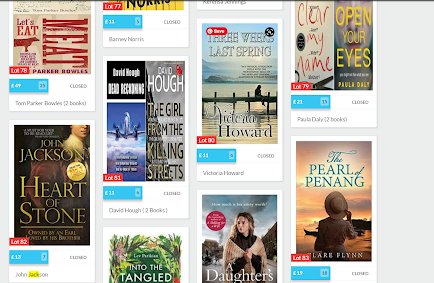
And for Readers? You see the widest choice of books in ALL genres, waiting for YOUR bid. From Kate Mosse to Lucinda Riley and Tom Kerridge, and of course, JK Rowling and Philip Pullman!

If your bid wins, you receive a signed and usually dedicated copy of the book – and ALL the money that you bid at auction goes straight to Children in Need!

On the hedgehog front we are having regular visits every night from what I think are two “boars”. No sign of any hedge-sows or hoglets yet, but we live in hope. Hedgies are very much solitary animals, and certainly “do not play well with others!” Their main reactions to each other are pushing and shoving matches, usually ending with the smaller hog assuming the “ball” position until the coast is clear.


And to close - remember, Carpe Diem!! Life sucks, but it's still better than the alternative, 
and I will let you know as soon as Paddy opens the Auction.