Showing posts with label Terry Lynn Thomas. Show all posts

Friday, 18 June 2021

What a Year – Its Strange Effects, Also Reflections on the Generosity of Authors


First things first! Leah Fleming, old friend, RNA member and reader of this blog pointed out that The Oxford Concise Dictionary of Quotations is a brilliant source of titles! And, of course, she is right.

So back to it!

This has surely been a year like no other – apart from 2020. The more things change the more they stay the same.

For me, the worst part of lockdown has been the physical isolation from family and friends, especially from my writing friends. At the time of writing, we have just had Covid restrictions extended for another month. It will be almost two years before we can see our younger daughter. At least we can see her sister and our granddaughter and hug THEM. When you are a grandparent, it takes extraordinarily little to keep you happy, and there IS light at the end of the tunnel.

Hopefully, my brain fog will lift, too. It’s probably part of advancing age and decrepitude, but we also find ourselves anchored inside a small circle of activities, and for both of us, all our energy has disappeared. We are both remarkably keen on a nap in the afternoon nowadays!  Still a change will be as good as a rest (surely). It may help stop the feeling of life being sucked from our brains!


---

July 1st is the middle day of the year, and also Canada Day, and my birthday. Also last year it was the day that the 2020 version of “Children in Read” was announced.

For those who have no idea what this is, it’s now a major charity fundraiser for the BBCs Children in Need appeal. Last year, it attracted about 600 contributing authors and raised almost £22,000. It was founded by a Liverpool businessman, Paddy Heron, who continues to organise and drive the event forward from year to year. Now in its seventh year, it has raised increasingly larger amounts each year.

Paddy normally “opens the shop” to donations in early July. Most authors are only too happy to donate a book. Children in Need, and Children in Read are both excellent causes to be associated with and have the highest approval of almost any charity in the UK. Last year I got involved and approached Jo Rowling and Philip Pullman, among others. Jo Rowling donated a copy of The Ichabod, and that went for £800. Philip Pullman donated three signed bookplates, and they went for about £350. Members of the Romantic Novelists Association seem to have taken the event to heart – about 200 members donated one or more books.

Once they are open, to donate a book is so easy! Just email Paddy Heron at childreninread@yahoo.com or Tweet (DM) to him (and Follow him) at @ChildrenInRead and tell him you would like to donate a book. All genres and all age-groups are welcome,  BUT NOT YET! 

What does Paddy need? Your name, with a “head shot” photo, your book title and a “cover shot” photo, your bio, and the “book blurb”. He also needs your Author web page and Twitter address. BUT NOT YET!

After the Auction, on November 13th, Paddy and the team will contact you with the details of the winning bid.  You then sign a copy of your book and post it to the winner!

Could it be easier, or more worthwhile? I don’t think so! 

Apart from being a great charity (Children in Need is arguably the best-known charity in the UK) I also see this as an outstanding promotion for ALL participating authors. To be there, on display, on an equal footing with the great and the good from ALL levels and genre of authors in the UK, is fantastic for “putting yourself out there”.  The auction website also comes with “share buttons” for Facebook and Twitter, making it extremely easy indeed to publicise your own generosity, and both the Charity and the Auction.
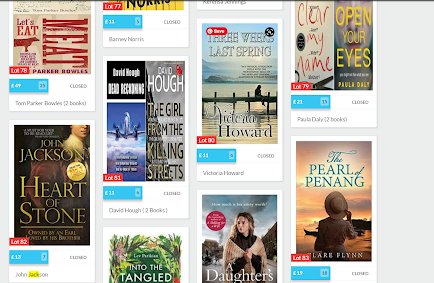


The costs for this are derisory – for me that works out at around £10 for the cost of a book, an envelope and UK postage. You would be mad not to!!!

And for Readers? You see the widest choice of books in ALL genres, waiting for YOUR bid. From Kate Mosse to Lucinda Riley and Tom Kerridge, and of course, JK Rowling and Philip Pullman!

If your bid wins, you receive a signed and usually dedicated copy of the book – and ALL the money that you bid at auction goes straight to Children in Need!

On the hedgehog front we are having regular visits every night from what I think are two “boars”. No sign of any hedge-sows or hoglets yet, but we live in hope. Hedgies are very much solitary animals, and certainly “do not play well with others!” Their main reactions to each other are pushing and shoving matches, usually ending with the smaller hog assuming the “ball” position until the coast is clear.


And to close - remember, Carpe Diem!! Life sucks, but it's still better than the alternative, 
and I will let you know as soon as Paddy opens the Auction.


Saturday, 12 June 2021

FIVE WAYS TO CREATE A WINNING STORY TITLE

Over the past year I’ve focused on flash fiction writing, completing how-to courses and entering competitions. One piece of advice that is repeated over and over is to choose your story title with care. This makes sense with flash fiction as competition entries usually sit around 250 to 500 words, some pushing the writer even further by allowing only 100 words. With such little material to play with and perhaps hundreds of entries to read, it’s understandable that judges prefer a title that shines. 

And much the same goes for a short story or novel. A title must be memorable, unique, intriguing, genre-appropriate. One that says to the reader ‘pick me, pick me.’ If this all sounds a touch daunting, never fear, as a quick internet search revealed some creative and quirky ways to come up with imaginative and winning story titles… 


RANDOM STORY TITLE GENERATOR 


The first thing I stumbled across was a list of random story title generators. Who knew such things existed? Most are FREE and they are more sophisticated than you might at first think, with different generators focusing on specific genres - Romance, Fantasy, Horror, Non-Fiction, Crime, Mystery, Children's and Comic Book titles. Even if they don't provide the perfect title for your piece, it's still helpful to have a go and hopefully find some inspiration along the way. Click on the link to discover a list of the Best Book Title Generators 2021, shared from the Kindlepreneur blog… FIND YOUR NEXT STORY TITLE HERE!


USE A CHARACTER'S NAME 


If your protagonist is a strong character, worthy of attention, then why not be bold and use their name as the title. My latest book group read was Angel by Elizabeth Taylor (the 20th century novelist, not Elizabeth Taylor the actress). The plot, as well as a cast of minor characters, revolved around Angel, so it made perfect sense that her name should be on the cover. Other examples that spring to mind are Oliver Twist, Jane Eyre, Eleanor Oliphant is Completely Fine, Rebecca, A Man Called Ove. Daniel’s Daughter by team member, Victoria Cornwall is another fine example. 

Use a character name...


WHAT IS THE STORY ABOUT? 


One purpose of the story title is to offer a hint as to what is to come, so it can be useful to consider the content and entice the reader with an attention-grabbing statement.  Excellent examples of this include The Hunger Games, The Devil Wears Prada, The Curious Incident of the Dog in the Nighttime, The Book Thief. Not forgetting great reads by our own team members including The Witness by Terry Lynn Thomas, and The Girl I Left Behind by Andie Newton 


Entice with attention-grabbing statements...


WHERE IS THE STORY SET? 


One of the joys of reading is being transported to another time or place and it can be useful for readers to know where they are headed. One of the easiest ways to do this is to signal the location in the title. Who could resist being swept away by the following; A Passage to India, The Paris Library, The Mermaid of Black Conch. We also have two fantastic examples from team members Kathleen McGurl (The Daughters of Red Hill Hall) and Linda Mitchelmore (Summer at 23 The Strand). 

Transport the reader to a fab location...


POETIC BOOK TITLES 

Still need inspiration? Then try reading some well-loved poetry or favourite song lyrics. All the following titles began life in a poem; The Lovely Bones, Of Mice and Men, Far From the Madding Crowd, I Know Why A Caged Bird Sings. Our own John Jackson's, Heart of Stone shares its title with both a beautiful poem and popular song.


Turn to poetry for inspiration...


So, if you are a writer, how do you choose a title? Do you have tricks or tips not already shared?  

I hope these pointers are handy, but most of all I wish you fun creating a whole stack of winning story titles.

Rae x


Sunday, 24 June 2018

TERRY LYNN THOMAS WITH THE SILENT WOMAN

Today we continue with our Question and Answer series, introducing a Novel Points of View author and their writing. I’m delighted that it’s the turn of our American team member, Terry Lynn Thomas and her historical fiction novel The Silent Woman.

Hello Terry,

Let's begin with a little teaser of what readers can expect in The Silent Woman 

Would you sell your secrets?

Catherine Carlisle is trapped in a loveless marriage and the threat of World War Two is looming. She sees no way out… that is until a trusted friend asks her to switch her husband’s papers in a desperate bid to confuse the Germans.
Soon Catherine finds herself caught up in a deadly mixture of espionage and murder. Someone is selling secrets to the other side, and the evidence seems to point right at her.

Can she clear her name before it’s too late?

1) Where did the inspiration for Cat’s character come from?
When I set out to write this series, I knew that I wanted a protagonist who was older and who lived outside the conventions of society. In The Silent Woman, when Cat is a suspect in her husband’s murder, she set herself up to be shunned by her friends and the social circles in which she runs. I spend a lot of time reading mysteries and fiction from the 1930s and 1940s, and I’m always taken aback by the way women are expected to take a certain subservient place in society. Even the most forward thinking people expect the woman to bow to her husband, not have a job, and not be too smart. I deliberately set out to shine the light on those issues, so I created Catherine Carlisle who is outspoken, sassy, sophisticated, intuitive, and — most importantly — doesn’t like to be told what to do. This sets the table for drama and turmoil surrounding her. The upside of Cat’s character is her commitment to helping others who are not as fortunate, be they man, woman, child, or animal. She really does have a soft spot.
I’m looking forward to letting Cat age through this series as well. Many writers leave their protagonists around the same age during the course and scope of their stories, but I’m going to let Cat grow old. This will allow me to explore social/economic conditions during and after World War II. I’m hoping to fashion her after the great spinster detectives of the past, namely Miss Silver and Miss Marple.

2) What drew you to this particular period, before the outbreak of WW2, when the powers that be choose to ignore Hitler’s flagrant violation of the Treaty of Versailles?
First of all, my father fought in World War II, so I have a soft spot for his generation. I also appreciate that during this time the people were united — and made sacrifices — to fight for freedom. I think a lot of things are happening now in the socio-political environment that we don’t know about. This is a scary time for the world in my view. And I don’t mean to sound trite, but the lessons of history are so important. I have a passion for politics, but the topic is so incendiary at this time that it’s difficult to have a cohesive conversation with anyone with whom you share a different point of view. This time period—long past—lets me explore issues that are relevant today without offending anyone. (True confession: I also love the clothes and the music.)

First in the Sarah Bennett Series
3) Compared to your Sarah Bennett mystery series, how much easier was it to research life in London in the 1930s? How do you prefer to conduct your research?
The Sarah Bennett mysteries were really easy to research because I lived and worked in San Francisco for a good portion of my life. My parents lived in the city, so I had stories handed down about the time. It was really easy for me to feel the vibe of San Francisco during the 1940s.
As for hands-on research, I read novels of the time, watch movies, plow through newspapers for nuggets, and let my imagination go wild. The secret is to gather all the historical data regarding day-to-day living, and then sprinkle it in with a light hand. It’s really important to be mindful of the reader in this regard. I don’t want to info bomb with historical facts and take away from the story. After I’m finished researching, my mind and my research binder are full of a lot of information that I will not use. It’s important to keep the research and history that I’ve learned relevant to the story.

4) What drew you to include characters with an interest in art?
I think I’m a frustrated artist. Someone once asked me if I could have any job in the world what would it be, and of course I said writing. But when I stepped away and thought about it for a while I realized how much I would love to get on a scaffold and restore works of art like the Sistine Chapel. So having characters in my books who are struggling artists is sort of a metaphor for me as a writer, and it also lets me explore my passion to create. I noodle around with pastel crayons. The result is horrible, but the process is very relaxing. At the end of the day, I love all forms of art and am inspired by those gifted with the ability to create it.

5) Which authors inspire your writing? Which books might we find on your beside table?
My favourite book by a living author is The Thirteenth Tale by Diane Setterfield. The story encapsulates all the things that make a story great for me: Gothic tropes, a love story, a mystery, superior sentences, and a twisty plot. I also love the way the author sets the book in a period before society was taken over by electronics, but she doesn’t specifically tells us when this is. It gives the book a haunting timelessness.

I re-read all the books by Agatha Christie (especially Miss Marple and the Beresfords), Patricia
Author, Terry Lynn Thomas
Wentworth, and (another author who is still alive) the Lady Julia series by Deanna Raybourn. I also love Susanna Kearsley, Rosamund Pilcher, and Maeve Binchey. I could keep going… My to-be-read pile is toppling. So many books. So little time. Since I broke my arm, I’ve been binge listening to audio books. I just listened to When Never Comes by Barbara Davis. It is rocking the best seller lists for good reason.

6) A little teaser about book two?
My writing came to a grinding halt after I broke my arm, but I am now mastering Dragon Naturally Speaking software and am dictating! I will tell you that Cat Carlisle just cannot seem to stay out of trouble. Can’t really say much more at this point, but followers of The Novel Points of View will be first to know developments about this book.

Thanks for hosting me, Rae.


You're very welcome, Terry. Thanks for providing us with an interesting insight into the inspiration for The Silent Woman and we look forward to following Cat's journey.

Join us next time when author and short story writer, Linda Mitchelmore will be in the spotlight.

Until then, happy reading!
Rae x
SaveSaveSaveSave