Showing posts with label Fiction. Show all posts

Friday, 18 June 2021

What a Year – Its Strange Effects, Also Reflections on the Generosity of Authors


First things first! Leah Fleming, old friend, RNA member and reader of this blog pointed out that The Oxford Concise Dictionary of Quotations is a brilliant source of titles! And, of course, she is right.

So back to it!

This has surely been a year like no other – apart from 2020. The more things change the more they stay the same.

For me, the worst part of lockdown has been the physical isolation from family and friends, especially from my writing friends. At the time of writing, we have just had Covid restrictions extended for another month. It will be almost two years before we can see our younger daughter. At least we can see her sister and our granddaughter and hug THEM. When you are a grandparent, it takes extraordinarily little to keep you happy, and there IS light at the end of the tunnel.

Hopefully, my brain fog will lift, too. It’s probably part of advancing age and decrepitude, but we also find ourselves anchored inside a small circle of activities, and for both of us, all our energy has disappeared. We are both remarkably keen on a nap in the afternoon nowadays!  Still a change will be as good as a rest (surely). It may help stop the feeling of life being sucked from our brains!


---

July 1st is the middle day of the year, and also Canada Day, and my birthday. Also last year it was the day that the 2020 version of “Children in Read” was announced.

For those who have no idea what this is, it’s now a major charity fundraiser for the BBCs Children in Need appeal. Last year, it attracted about 600 contributing authors and raised almost £22,000. It was founded by a Liverpool businessman, Paddy Heron, who continues to organise and drive the event forward from year to year. Now in its seventh year, it has raised increasingly larger amounts each year.

Paddy normally “opens the shop” to donations in early July. Most authors are only too happy to donate a book. Children in Need, and Children in Read are both excellent causes to be associated with and have the highest approval of almost any charity in the UK. Last year I got involved and approached Jo Rowling and Philip Pullman, among others. Jo Rowling donated a copy of The Ichabod, and that went for £800. Philip Pullman donated three signed bookplates, and they went for about £350. Members of the Romantic Novelists Association seem to have taken the event to heart – about 200 members donated one or more books.

Once they are open, to donate a book is so easy! Just email Paddy Heron at childreninread@yahoo.com or Tweet (DM) to him (and Follow him) at @ChildrenInRead and tell him you would like to donate a book. All genres and all age-groups are welcome,  BUT NOT YET! 

What does Paddy need? Your name, with a “head shot” photo, your book title and a “cover shot” photo, your bio, and the “book blurb”. He also needs your Author web page and Twitter address. BUT NOT YET!

After the Auction, on November 13th, Paddy and the team will contact you with the details of the winning bid.  You then sign a copy of your book and post it to the winner!

Could it be easier, or more worthwhile? I don’t think so! 

Apart from being a great charity (Children in Need is arguably the best-known charity in the UK) I also see this as an outstanding promotion for ALL participating authors. To be there, on display, on an equal footing with the great and the good from ALL levels and genre of authors in the UK, is fantastic for “putting yourself out there”.  The auction website also comes with “share buttons” for Facebook and Twitter, making it extremely easy indeed to publicise your own generosity, and both the Charity and the Auction.
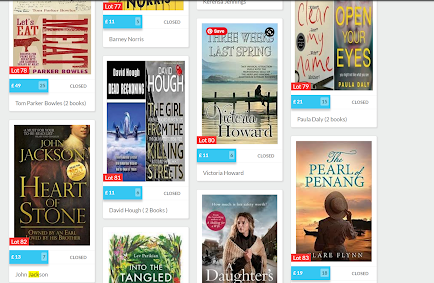


The costs for this are derisory – for me that works out at around £10 for the cost of a book, an envelope and UK postage. You would be mad not to!!!

And for Readers? You see the widest choice of books in ALL genres, waiting for YOUR bid. From Kate Mosse to Lucinda Riley and Tom Kerridge, and of course, JK Rowling and Philip Pullman!

If your bid wins, you receive a signed and usually dedicated copy of the book – and ALL the money that you bid at auction goes straight to Children in Need!

On the hedgehog front we are having regular visits every night from what I think are two “boars”. No sign of any hedge-sows or hoglets yet, but we live in hope. Hedgies are very much solitary animals, and certainly “do not play well with others!” Their main reactions to each other are pushing and shoving matches, usually ending with the smaller hog assuming the “ball” position until the coast is clear.


And to close - remember, Carpe Diem!! Life sucks, but it's still better than the alternative, 
and I will let you know as soon as Paddy opens the Auction.


Saturday, 27 March 2021

In which we discuss continuing education.

Often when  I’m in between books I take time to study my craft and hone my writing skills. My usual custom and practice is listen to chapters three and four of the audio version of Save the Cat Writes a Novel by Jessica Brody. Even though I already know the book by heart, listening to the chapters about character development and story structure never fails to get me motivated. But 2020 was a total pain in the you-know-what of a year, so for my third Olivia Sinclair book, I decided to try something different. Luckily, I was able to get a spot in The Tarot for Fiction Writers workshop over at thewriterscircle.com. 

The instructor, Kris Waldherr, not only writes amazing novels, she is also the artist who drew and created The Goddess Tarot deck. Her latest novel, The Lost History of Dreams is a fabulous gothic novel, which released to critical acclaim in 2019. Kris’s unique skillset lets her navigate the world of tarot and novel writing with deft. Her curriculum in the Tarot for Fiction Writing Class specifically helps students negotiate the obstacles all writers face when crafting story. (Anyone interested in any of Kris’s workshops can find out info here.) 

The tarot consists of seventy-eight cards, each depicting a nugget of the human condition. Arranged in certain order, the images can reveal patterns about  the day-to-day things we humans struggle with, as well as the things we celebrate. Taken as a whole, the tarot deck can be mixed and matched and arranged anyway the writer wants to jibe with their story, their scene, or their attitude about their work. 

During the course, we’re given examples of tarot spreads as reflected by known works of fiction. Each week we learn a new type of spread for character development, story arc, character arc, and even spreads for motivating the beleaguered writer who hits the proverbial wall. So while the tarot isn’t a supernatural fortune telling system (Write this book and you will have a best seller… Don’t I wish.), it’s definitely a way to memorialize and capture fleeting bits of humanity, which can then be layered into your story, your characters, and into the writing process itself. 

There’s something mysterious and lovely about tarot cards and their ancient symbols. As I shuffle the deck and look at the images, my subconscious mind comes to life and responds to what I see. Characters become more deeply known as their motivation becomes clear; the fog clears in my writer’s brain and I see the way out of a plot hole. The tarot, it seems,  is a magical shovel for digging deep on all fronts. And that, dear reader, has made my writing life very interesting indeed. 


Quick note about the above picture: Ace of Cups (divine grace in artistic endeavors), The Moon (mysticism, creativity), Ace of Pentacles (new opportunities, abundance coming)

How about you? Have you ever used tarot or any outside source to stimulate your inner storyteller? 

Until next time.

Terry


Saturday, 19 October 2019

WHAT DOES YOUR BOOKSHELF SAY ABOUT YOU? by Victoria Cornwall

I have spent the last month undertaking a big clear out of my home. The things I no longer needed (or liked) were either sent to our local charity shop, recycling centre or thrown away. It was hard work, cathartic and a good time to identify what material things really mattered to me. One of the things that had a good sort through was my bookshelf.
I am a Poldark fan. Many years ago I bought the complete series which were twelve books in all. Over time, and after several readings, the pages have become yellow and dogeared. The first six books were very special to me as their covers had the actors from the 1970s TV series on them. However the remaining covers were mismatched, some of which displayed people who, in my mind, had no resemblance to the characters in the books. It was time to treat myself and buy a new complete set, preferably with the up-to-date, gorgeous covers which display the actors from the most recent adaptation. They would look neat on my bookshelf, thought I, make a perfect stylish set and show I was a big Poldark fan. It also accurately reflected my hobby of reading quality fiction with realistic historical facts. The size of the series would show any visitor that I am a serious reader (yes ... I have read all 12 books folks!) and I know a good thing when I see it (it's a classic after all!). This got me thinking, was I trying to project an image of who I wanted people to think I am or would the bookshelf silently show the real me?
I began to wonder if all bookshelves told us something about the reader. Could a chaotic, mismatched, overloaded bookshelf point to someone who is disorganised and unwilling to part with material things? Or did it tell us that the owner just loved books and wanted to keep them to read again and again?
If a bookshelf is arranged alphabetically or by colour, is the person organised and efficient or painfully controlling with too much time on their hands? Are books arranged by genre preferred by people who like to compartmentalise their lives, or does a variety of genres show that their owner is open to trying new things and will have a broad outlook on life?

By now my mind was in overload. Does the actual type of book chosen for display tell us something? Crime, fiction, autobiographies, travel ... there are certainly lots to choose from. Are we showing the world our innermost soul or the sort of person we aspire to be?
The "coffee table book" is a good example of the latter. It is usually large and expensive, with a lot of pictures, specifically designed to be looked at rather than read. Needless to say it is usually placed where people can see it easily, such as a coffee table. Is the owner really saying, "I am a good host as I have provided a book for you to look through while I prepare you a drink" ... or is it less about the guest's comfort and more about the owner wanting the guest to know that they are stylish and can afford a luxurious quality book that they don't really need.
Of course the books that don't make it to the bookshelf are just as telling. Reading an erotic book, but hiding it in the bottom drawer rather than displaying it on a shelf would certainly show there is a part of one's life the reader would rather keep private, despite the enjoyment it may give. Yet if the erotic book did make it to the shelf, it would show that the reader exuded confidence and had a "take me as you find me" attitude. This attitude is admirable, although one's reaction to viewing such a bookshelf might depend on the book ... and the number of them. Too many and too jaw droppingly kinky, one might just be tempted to run ... unless you are into that kind of thing. In that situation you will be delighted to discover you have found a kindred spirit who might enjoy dressing up in black studded straps and leather chaps too.
Does an array of fiction or travel books show that the reader is looking for an escape? Perhaps "real crime" books show a forensic, inquisitive mind? Do self-help books show someone seeking to take control of their lives or are they mere followers of yet another fad? I am intrigued to know the truth and will look at other people's bookshelves a little more closely next time.

Did I bin my original precious Poldark books with the original actors on the cover? No, I did not. My reorganisation and expensive purchase may hint that I am organised (the new book series is complete and in perfect alignment), stylish (they do look pretty and photogenic) and  show my interest in historical fiction with a strong romantic thread, (which is my preferred genre and the type of book I like to write myself). However, sitting neatly beside this spanking new set will be my six dogeared original Poldark books, which I like to think shows my soft nostalgic centre and undying loyalty to something that once played a big part in my teenage years.

Sometimes something which is losing its colour and curling at the edges is every bit as special as something sexy and spanking new ... at least that is what I remind my husband as I celebrate another birthday and spot yet another grey hair in the mirror. 
Victoria Cornwall
What does your bookshelf say about you?


Saturday, 9 March 2019

Adding Realism To Your Writing by Victoria Cornwall

A novel is like the inside of an intricate clock. Just like the well-oiled cogs and gears of a clock, a book has many elements which need to interact smoothly so it provides an enjoyable read. This week I am going to chat about a character’s reaction to a given situation. Their reaction is one of those key elements. A good reaction can strengthen the reader’s interest in the character or plot  … a poor, ill-written reaction can lose a reader’s support and loyalty.
As a writer, I try to imagine how the character would behave and think in any given situation and describe it as accurately as I can. However, over the years I have come to realise that people do not always behave how we would expect them to. If a writer captures this unexpected reaction in their writing, it can add realism to the situation and more depth to the character. It can also add an unexpected twist. Here are two examples of what I am trying to explain. They are both related to losing someone special:-
Imagine you are writing about a young widow learning how to navigate life again without her husband by her side. The story starts with a scene of her sitting by her husband’s hospital bed. They are holding hands as he finally succumbs to a long, drawn out battle with cancer. The last two years have been particularly brutal. The normal emotions of denial, shock and heart rendering grief come to mind. Scenes involving tears, emotional numbness, relatives offering comfort, doctors saying things that in the moment make no sense. Those scenes are in her future, but right now she is still holding his hand as it begins to grow colder in hers. Her love, her soul mate, her friend has just left her forever. The perfect reactions to her husband’s passing are just waiting to be written. But wait! STOP and think again.
Remember that she has just spent years by his side battling cancer. The last two years have been particularly bad. What if his personality had changed over that time? What if he had not accepted his diagnosis well and had railed against the unfairness of it all. She had nursed him up to the point of his admission to hospital and she is now in a state of physical and mental exhaustion. Her love for him had changed as his illness had changed him. The happy years of their marriage are a distant memory as his anger, frustration and physical changes had eaten away at their marriage as efficiently as the cancer inside him. He was not the man she fell in love with. What if she felt a great sense of relief at his passing? Imagine the guilt she would have at experiencing such feelings. She would feel unworthy of the sympathy offered by friends and relatives. She would feel like a fraud. In the story she will eventually learn to understand her husband's reaction to having cancer, understand her own reaction to living with someone she no longer recognised and finally forgive both her husband and her reaction to living with cancer. She will fall in love with her husband all over again as her memories of their happier times together become easier to recall. She has to do all this before she can grieve normally again and feel the true depth of her loss. Finally she learns to live without him, but her initial “abnormal” reaction actually adds realism and an extra dimension and twist to the normal grief process. Her reaction may at first seem abnormal, but it is actually very realistic. Chronic illness is a terrible strain on family members and we can add this side into our story too.
I used to work in intensive care as a nurse. After the death of a patient, I came across his son sitting in the corridor. I sat down beside him ready to offer words of comfort. We were both in our mid-twenties and had never spoken before.  Back then, if I was to write the scene, I would have had him expressing his grief at losing his father, perhaps eyes brimming with tears, hands trembling in grief, reactions all equated with grief. The reality was very different. Although he was very distressed, he did not show it in the normal way. His mind was whirring and he was agitated as he didn’t know how to arrange all the practical things to do with a death in the family.  He gave the impression of being rather selfish – only thinking of himself and all the jobs he had to do. Where would he get the death certificate from? How would he move the body to the funeral directors?  Who would he have to notify? His father had died yet he was talking as though it was a problem to be solved. However, I understood his thought processes as not long before I had been in a very similar situation.
He had no experience of dealing with a death in the family. He felt ill prepared and knew little about how to sort out funerals, wills, death certificates etc. The one man he would normally turn to for advice was no longer there and he was in panic mode. He felt his loss very deeply, but expressed it in a different way and was overwhelmed by the practicalities facing him. He wanted to be a support to his mother and protect her by doing all the practical things required, but he felt totally inadequate for the jobs ahead. He felt that he was already failing his father and as he sat outside the intensive care unit, numb with shock, he spilled out his worries to a nurse who happened to sit down beside him. Luckily, from my recent experience, I could help him more than most.

So just remember, although it is important for a character’s reaction to be a believable one, sometimes you can add depth, a twist or an added layer to a plot or character, by allowing them to react in a way that is not quite what one would expect.


Fiction by Victoria Cornwall


Friday, 16 November 2018

IF ONLY THE WALLS COULD TALK ... OR MAYBE THEY DO by Victoria Cornwall

Buildings can form a great backdrop to a scene, but they can also be used to tell us about the characters’ mind-set, past and even their future. Buildings can show the passing of time, add tension to a scene or show the class the character has been born into or aspire to join. Buildings are an amazing tool and are, in my opinion, not used to their full potential, yet they can draw a reader into the story and help them to walk in the footsteps of the characters themselves.
An example of this is Manderley, the house in Dauphne Du Maurier’s Rebecca. It holds a sense of doom for the new Mrs De Winter. Its rooms feel haunted by her husband’s former wife, the heirlooms are hers and even her portrait still hangs on the wall and gets her into trouble. In addition to all this, the housekeeper constantly reminds the new wife how Rebecca liked to run it. Little by little the present Mrs De Winter feels overshadowed by the former wife as her confidence is gradually whittled away. Mrs De Winter never meets Rebecca in the novel, she doesn't need to. The house is a constant, imposing reminder of how great her husband's former wife was and the housekeeper uses the building to her full advantage to taunt her about this every moment she can.

When I wrote A Daughter's Christmas Wish, I ensured that each main character had a building linked to them which helped to tell their story.
The heroine, Rose, feels lonely and trapped in her unexciting life living with her parents. Her mother still grieves for the loss of her son and is unable to move on in her life. Their home reflects this and, hopefully, the reader will be able to empathize with Rose's feeling of being trapped in a dull life. If only she had someone who could help her to feel festive again as Christmas approaches … cue the arrival of a lone soldier, called Nicholas.
Nicholas has returned from the Great War and has a promise to fulfil - to give a fellow soldier’s fiancé, Rose, the Christmas she has always wanted. Once again I have used his home to show his class, the past he has tried to hide from and how the passing of time (and war) have changed it. He also imagines the future too, which I hope shows his mindset in that moment.
Yet for these two people, who are from very different classes, to meet I needed a neutral setting and, for the first time in my writing career, I used a place of work – a teashop. This allowed them to meet and be alone together, an oasis for their festive countdown to Christmas to begin and their relationship to grow. It is where shy Rose feels most confident. This allows her to blossom and think about leaving her grief for her fiance behind her. Hopefully the reader will feel that they are watching Nicholas and Rose from a quiet corner of the room as these two people learn to live in peacetime again.

As a writer one must use all the tools at hand. We often use smell, taste, sound, feel, sight, thought and internal emotions to convey what our characters are experiencing, but the buildings that form a backdrop to their lives can also speak volumes - in their own quiet way.
A Daughter's Christmas Wish
Available as an ebook & audiobook from 20th November, 2018.
Available to pre-order today. 

Saturday, 19 August 2017

NOVELS TO ENRICH A TRIP TO THE FLORIDA KEYS ... by Rae Cowie

Reading and travel are my two great loves and whenever I find the opportunity to combine them then I’m a happy soul. In recent years I’ve tried to read at least one novel set in the place I’m about to explore. So when we decided to visit the Florida Keys on a family holiday, I knew exactly which book I would choose – Vanessa Lafaye’s stunning historical debut, Summertime (A Richard and Judy BookClub Choice for 2015). A novel based on real life events, which graced my ‘to be read’ list for far too long.

FLORIDA KEYS
Set during the 1930s on the fictional Heron Key, we’re introduced to Missy, loyal maid to the Kincaid family, who spends years of her prime waiting for her first love, Henry, to return from the battlefields of France. Trouble is brewing, as a hurricane threatens the coast, turning everything, including Missy’s life, upside-down. (Here's my full Goodreads review - Summertime Review .) Summertime is a fantastic debut, made even more special for me when I went on to read the author’s notes and discovered that the real life events on which Vanessa based her novel took place in Islamorada – the island we’d chosen to stay on the Keys.

Islamorada Hurricane Memorial

ISLAMORADA HURRICANE
As we drove South on day trips, we passed a hurricane monument, which, if it weren’t for reading Summertime, I may not have given a second glance – which would’ve been a shame because I would have missed learning about perhaps the single most important event in the history of Islamorada. But because I read Summertime I understood the importance of the memorial. So we stopped and read the tragic tale of the brave WW1 veterans who, whilst working for the government, were treated shabbily by a system that chose to ignore the natural danger heading their way. Because I’d met and admired Vanessa’s fictional characters, her writing made me take time to reflect on the suffering endured
The true story behind 'Summertime'
by the real inhabitants of Islamorada, during the catastrophic 1935 Labor Day hurricane, when 200mph winds created 18 foot tidal waves, which swamped the low-lying sea town with appalling loss of life, demolishing most of the buildings. A sobering thought.


HISTORY BEHIND THE NOVEL
As we journeyed on past ocean front villas butting up against water bluer than a skimming dragonfly, heading to the lively tropical port of Key West, we commented on the strange sight of a bridge half-built, or broken - we weren’t sure.
Partially completed railway bridge (Florida Keys)
When I posted my book review on Goodreads, Vanessa was kind enough to get in touch and pointed me in the direction of her fascinating Pinterest board entitled ‘The History Behind The Novel’. It was there I discovered that the partially completed railway bridge we’d seen was the same bridge the WW1 Veterans, including Vanessa’s fictional hero, Henry, were working on when the hurricane struck.


METICULOUS RESEARCH
I feel grateful to Vanessa as her time in meticulously researching the events which led to such a tragedy added so much more to my stay in Islamorada and also to my understanding of the danger of the deadly force of nature capable of destroying the breathtaking beauty of the Keys.

The Green Turtle Inn
 today
As we drove past the flashing neon green light of the Green Turtle Inn, one of the few buildings that survived the storm, I couldn't help but remember the terrified residents who gathered there, seeking shelter, after the worst of the hurricane blew through.


It's a heart-breaking real life story, but the characters in Summertime display both courage and hope for the future. Islamorada has been rebuilt and is thriving as a popular fishing and tourist resort, once again. I'd love to return one day!
Islamorada - July 2017


FURTHER READING
If you’d like to see more photos of what inspired Vanessa to write Summertime, or learn a little more about a largely forgotten piece of American history, then I’ve included a link to her Pinterest page here.

Also, I can’t sign off without mentioning that having very much enjoyed Summertime (even if you can’t visit the Florida Keys, it’s still a brilliant read), I then went on to enjoy the companion novel, At First Light. This time our journey into the past begins during a 1993 Klu Klux Klan rally in Key West, when Alicia Cortez, a frail elderly Cuban woman, commits murder in broad daylight. To understand Alicia's motives Vanessa then carries us back to Key West of 1919, a wild, colourful frontier town filled with brothels and soldiers and bars. Again, At First Light, is loosely based on disturbing true events, which are sadly still pertinent today and which warrant a blog post all of there own! In the meantime, here’s my full Goodreads review.

So where will I travel to next? – Perhaps I should consult my bookshelf...

WHICH BOOKS HAVE ENRICHED YOUR TRAVEL EXPERIENCES?
But before you head off, please share which novels have enriched your travel experiences. (The Trip Fiction website is great for inspiration.) I’d love to hear some of your favourites…

Happy reading!

Rae
SaveSaveSaveSave