Showing posts with label authors. Show all posts

Friday, 18 June 2021

What a Year – Its Strange Effects, Also Reflections on the Generosity of Authors


First things first! Leah Fleming, old friend, RNA member and reader of this blog pointed out that The Oxford Concise Dictionary of Quotations is a brilliant source of titles! And, of course, she is right.

So back to it!

This has surely been a year like no other – apart from 2020. The more things change the more they stay the same.

For me, the worst part of lockdown has been the physical isolation from family and friends, especially from my writing friends. At the time of writing, we have just had Covid restrictions extended for another month. It will be almost two years before we can see our younger daughter. At least we can see her sister and our granddaughter and hug THEM. When you are a grandparent, it takes extraordinarily little to keep you happy, and there IS light at the end of the tunnel.

Hopefully, my brain fog will lift, too. It’s probably part of advancing age and decrepitude, but we also find ourselves anchored inside a small circle of activities, and for both of us, all our energy has disappeared. We are both remarkably keen on a nap in the afternoon nowadays!  Still a change will be as good as a rest (surely). It may help stop the feeling of life being sucked from our brains!


---

July 1st is the middle day of the year, and also Canada Day, and my birthday. Also last year it was the day that the 2020 version of “Children in Read” was announced.

For those who have no idea what this is, it’s now a major charity fundraiser for the BBCs Children in Need appeal. Last year, it attracted about 600 contributing authors and raised almost £22,000. It was founded by a Liverpool businessman, Paddy Heron, who continues to organise and drive the event forward from year to year. Now in its seventh year, it has raised increasingly larger amounts each year.

Paddy normally “opens the shop” to donations in early July. Most authors are only too happy to donate a book. Children in Need, and Children in Read are both excellent causes to be associated with and have the highest approval of almost any charity in the UK. Last year I got involved and approached Jo Rowling and Philip Pullman, among others. Jo Rowling donated a copy of The Ichabod, and that went for £800. Philip Pullman donated three signed bookplates, and they went for about £350. Members of the Romantic Novelists Association seem to have taken the event to heart – about 200 members donated one or more books.

Once they are open, to donate a book is so easy! Just email Paddy Heron at childreninread@yahoo.com or Tweet (DM) to him (and Follow him) at @ChildrenInRead and tell him you would like to donate a book. All genres and all age-groups are welcome,  BUT NOT YET! 

What does Paddy need? Your name, with a “head shot” photo, your book title and a “cover shot” photo, your bio, and the “book blurb”. He also needs your Author web page and Twitter address. BUT NOT YET!

After the Auction, on November 13th, Paddy and the team will contact you with the details of the winning bid.  You then sign a copy of your book and post it to the winner!

Could it be easier, or more worthwhile? I don’t think so! 

Apart from being a great charity (Children in Need is arguably the best-known charity in the UK) I also see this as an outstanding promotion for ALL participating authors. To be there, on display, on an equal footing with the great and the good from ALL levels and genre of authors in the UK, is fantastic for “putting yourself out there”.  The auction website also comes with “share buttons” for Facebook and Twitter, making it extremely easy indeed to publicise your own generosity, and both the Charity and the Auction.
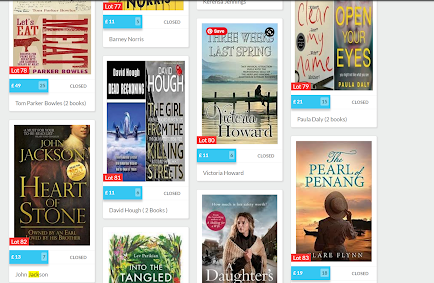


The costs for this are derisory – for me that works out at around £10 for the cost of a book, an envelope and UK postage. You would be mad not to!!!

And for Readers? You see the widest choice of books in ALL genres, waiting for YOUR bid. From Kate Mosse to Lucinda Riley and Tom Kerridge, and of course, JK Rowling and Philip Pullman!

If your bid wins, you receive a signed and usually dedicated copy of the book – and ALL the money that you bid at auction goes straight to Children in Need!

On the hedgehog front we are having regular visits every night from what I think are two “boars”. No sign of any hedge-sows or hoglets yet, but we live in hope. Hedgies are very much solitary animals, and certainly “do not play well with others!” Their main reactions to each other are pushing and shoving matches, usually ending with the smaller hog assuming the “ball” position until the coast is clear.


And to close - remember, Carpe Diem!! Life sucks, but it's still better than the alternative, 
and I will let you know as soon as Paddy opens the Auction.


Saturday, 4 May 2019

LEARNING FROM THE SUCCESSES AND FAILURES OF OTHERS by Victoria Cornwall

'Literature cannot be the business of a woman's life: & it ought not to be.'
Poet Laureate
Robert Southey
 Letter to Charlotte Brontë.
At the beginning of her writing career, Charlotte Bronte sent copies of her verses to the poet laureate, Robert Southey, for his feedback. His harsh assessment, quoted above, must have been painful to read, but the path to publication is often littered with criticism and rejection, a lesson Charlotte was about to find out.

It was not until May, 1846, when she joined forces with her sisters, Anne and Emily, did Charlotte finally see her poems in print. However the momentous day came at a cost, both financially and emotionally. Although the verses were published by Aylott and Jones, Charlotte and her sisters had to use their inheritance from an aunt to pay the expense of publication. Yes, they self-published! They would not have the joy of seeing their names on the cover as they felt it necessary to use male pseudonyms to avoid discrimination based on their gender.

Following this, Charlotte and her sisters tried to have their novels published. Charlotte's first novel, The Professor, was repeatedly rejected. It would be published later, but not until after her death. Her second attempt, a novel called Jane Eyre: An Autobiography, was more successful and was finally published in October, 1847. Once again Charlotte used her male pseudonym of Currer Bell. It went on to become a best-seller. Following its success, Charlotte finally revealed herself as the writer. I wonder if she recalled Robert Southey's harsh words as she walked into her publisher's office to introduce herself as the author.
There are many stories relating to an author's bumpy journey to publication. The international best seller, Stephen King supposedly nailed his rejection letters to a wall, replacing it with a spike when it could no longer cope with holding them. It would take six years of rejection letters before his first short story was published. His first novel, Carrie, was rejected thirty times, but eventually went on to sell over a million copies. King takes us on his painful writing journey in his memoirs and writing tips, Stephen King On Writing and, like many writers, it took him many years to be an overnight success.
Through her detailed and technically accurate illustrations, Beatrix Potter became a scientific illustrator long before her fiction career took off. Her first work of fiction, The Tale of Peter Rabbit, was initially less successful and turned down my several publishers. Determined to see it in print, Potter felt compelled to publish it herself. A traditional publisher finally took it on and published it in 1902 on the agreement that Potter would replace the black and white illustrations with coloured ones. Needless to say, The Tale of Peter Rabbit and her subsequent books, quickly became children's classics.
Agatha Christie is world famous for her detective novels, but her quest to be published was as difficult to solve as the majority of her crime novels. Magazines rejected all of her early short story submissions and her first novel, Snow Upon the Desert in Cairo, also received the same fate. Hercule Poirot, the detective who feature in so many of her novels, finally came to her rescue. His first appearance in The Mysterious Affair at Styles was initially rejected, but the manuscript finally found a home with John Lane at The Bodley and was published in 1920. Christie went on to write  66 detective novels, 14 short story collections, the world's longest-running play, The Mousetrap, and (under the pen name Mary Westmacott), six romances.

So what can we learn from these successful writers? I think H.G.Wells sums it up very well.

The only true measure of success is
the ratio between what we might have done and what we might have been
on the one hand
and
the thing we have made and the things we have made of ourselves
on the other hand.
H.G.Wells

In other words, keep going and keep improving ... and you will be more successful than if you didn't try. It is a valuable life lesson to learn, whichever path we choose to tread.

In April, I celebrated the publication of my fifth novel, Daughter of the House. Were my first attempts at being a published author initially rejected? Yes, several times! Those rejections crushed me and I nearly gave up writing, however today they are just distant memories of an experience I once had ... an experience shared by many of the bestselling writers of our time. My conclusion is that I am in good company and the challenges we face are nothing to be ashamed of.


By