The Not-So-Secret Seven. Writers and bloggers passionate about creativity - spilling the beans on writing, narrative, reading and more … Do join us and enjoy.
Saturday, 27 April 2019
A MATTER OF LIFE AND .............................................................. By Linda Mitchelmore
...... I think you all know what word comes next - yes, the 'd' word. Picture the scene - I was sitting, drinking a lovely glass of chilled Prosecco and chatting to my cousin Barbara who had been asking me about my writing .... what was coming next, plot and so on. We moved on to ALCS (Authors Licensing Collection Service) and PLR (Public Lending Rights) and then onto Royalties. I said they were all nice little earners, to which Barbara responded by saying, 'All very interesting, but what happens to it when you're dead?'
Crikey but that sort of conversation pulls you up short! But what does happen to it? I had no idea back then. However, I'm a member of the Society of Authors and I guessed they might know.
They do as it happens. They produce a most excellent leaflet - free to members, but £20 to anyone else - entitled, GUIDANCE ON YOUR COPYRIGHTS & PAPERS AFTER DEATH. It's rather a stark heading but it does what it says on the tin. After that initial conversation I imagined Royalties might live on to anyone to whom we bequeath them but I had no idea that ALCS and PLR do, but they do as well. The surprise has been that even if a writer isn't a member of the SoA prior to death their estate can apply and be a member with all the same benefits. There are various sections (seven if I remember rightly), all very clearly explained and laid out. WILLS AND POWERS OF ATTORNEYS, WHO INHERITS WHAT ON YOUR DEATH, INHERITANCE TAX are but three.
All this has made me pause for thought .... and it dredges up all sorts of uncomfortable feelings and I think it's a travesty that any of us have to hand back the pen, as it were. So, to whom will I leave not only my small - but exquisite to my mind - collection of paintings, and my very, very, small collection of jewellery comprising two rings? In June this year I'll have the copyright of nine novels to pass on. I doubt my grandchildren will reap the benefits that Agatha Christie's grandson did when she left him the rights to the Mousetrap in her will, but mine could still be a nice little earner and buy a decent bottle of Rioja at Christmas.
So .... there we have it - something writers really, really need to think about. And best done with your tipple of choice in hand, and possibly chocolate .....
Saturday, 20 April 2019
Evolving Language: How to Talk About Cats
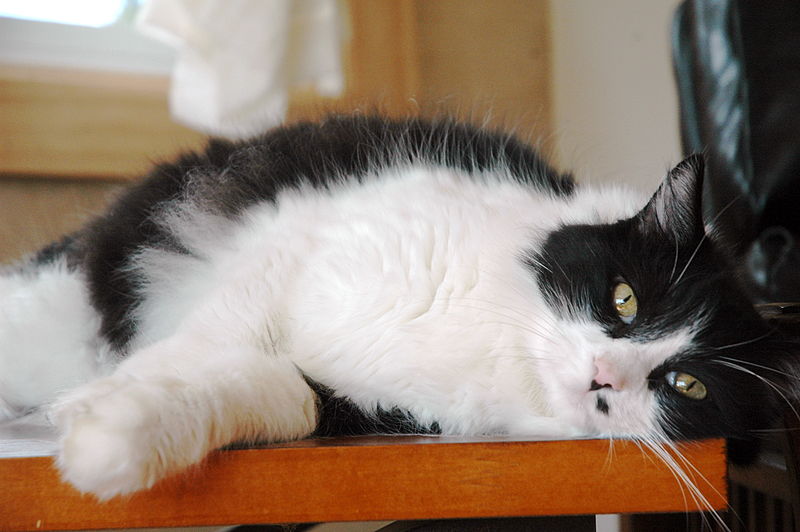
| A magnificent floofy cloud... Image from Sheryl Leigh, via Wikimedia (public domain). |
There are fat cats and thin cats, smart cats and cats that are what we’d call in Scotland “thick as mince”. There are appealing cats and appalling cats. There are cats in high places — such as Larry the Number 10 cat, Palmerston the “diplomog” and other governmental felines with their own Twitter feeds. Some of my happiest places in the sewer that social media can be are Facebook groups where people post random photographs of strange cats, or of their own pets.
As I’ve tripped merrily through this forest of feline felicity, I’ve noticed a strange thing. It’s to do with language. Cats, when they’re not slaying you with a look, are more than capable of communicating via meows and hisses and chirps or, in the case of my own elderly moggy, deafening wails in the dead of night, but that’s not what I’m talking about. I’m talking about how we, their humble servants, talk about cats.
Language evolves and it fascinates me to watch it in action. Cats in general might be known as cattos rather than cats, or sometimes as floofs, a word often preceded by the adjective “majestic”. Those with long fur, especially all white, all black or all grey, are fondly referred to as clouds.
![]() |
| Look closely: this cat has a blep |
I’m sure other animal groups develop their own language. In fact, I know they do, because sometime I venture into rabbit — sorry, bun — circles, where I have learned the difference between a binky and a sploot.
I love seeing how people develop their own secret languages to cover their own interests…and I wonder how long it will be before some of these terms make it into the dictionary, if they haven’t already. And what about my readers. Do you have any favourite (repeatable) words?
Apology: dear spellchecker, I’m very sorry. I know this article almost broke you…
Jo Allen
Saturday, 13 April 2019
Rewriting the Classics
For today's joint blog, we discuss which classics we'd like to rewrite, or see rewritten.
Jo Allen kicks off the discussion:
I love the Brontes. Who doesn’t? (I mean, surely somebody, somewhere, doesn’t, but…)
So the novel I would like to rewrite for the modern day is the most rip-roaring of them all, Anne Bronte’s fabulous, scandalous The Tenant of Wildfell Hall. These days we’d call it romantic suspense and it has everything, so much so that if you don’t know it I recommend you go and look up a plot summary.
In short, Gilbert Markham falls for the mysterious widow in the neighbouring hall who it turns out, isn’t a widow at all but on the run from her drunken, violent husband. He, of course, comes after her and we have a chase and a misunderstanding, in the midst of which poor old Gilbert (who always struck me as not quite able to keep up with the extraordinary Helen Graham) doggedly pursues her, the love of his life.
If there’s a real kickass heroine in any of the Bronte novels it has to be Helen, unprepared to stand for the kind of nonsense her debauched husband and the restrictions of society place upon her. I love her to bits.
Having said all this, I don’t quite know how one would go about modernising a novel so far ahead of its time. Dare I say it, but I think Gilbert could do with a bit of a makeover. Then perhaps he’d be a match for Helen… and imagine what a film Hollywood could make of that…
Victoria Cornwall also chooses the Brontes:
Wuthering Heights was Emily Bronte’s only novel and was originally published under the pseudonym Ellis Bell. The initial reviews were mixed, some critics finding the unsavoury characters, hatred, revenge and violence difficult to accept, despite the novel being a compelling read.
Even today I find Heathcliff, the “hero” of the love story, difficult to accept. He starves a trapped bird, verbally and physically abuses his wife and damages the lives of all those around him … all in the name of love. Well in my opinion, loving someone does not give you the excuse to be a violent thug who destroys people who happen to be in their orbit. My adaptation would have Heathcliff coming to his senses and rescuing the bird in time and being emotionally distant from his wife (as he still loves Cathy) but not intentionally cruel to her. As he is Heathcliff, I will still allow him to behave badly, but ultimately he has to come to his senses and regret his behaviour. For my adaptation, Heathcliff has to deserve meeting up with Cathy in death, and unless he has changed his ways, I just wouldn’t let him. No woman deserves to be with a violent man, in life, in fiction or beyond the grave.
Rae Cowie picks something completely different:
Which literary classic would I re-write and why? For this writing challenge I’m reaching over to the dark side, choosing Daphne du Maurier’s chilling short story, The Birds (adapted for screen by Sir Alfred Hitchcock). However, I would never presume to improve upon such a perfect piece of Gothic literature, but instead would have a bash at composing a modern-day version.
In du Maurier’s original story, ever more violent flocks of birds attack the family of farmer Nat Hocken, who responds by fortifying his home. Today, many farmers feel assaulted not only by the usual stresses of unpredictable weather and rising costs, but also from the increasing divide between urban and rural life. This leads to a feeling that society no longer appreciates their work, compounded by abuse on social media from activists interested in veganism, animal welfare, the climate change lobby and so on… Pinching tricks from du Maurier, I’d build on the farm’s isolated location. What begins as a stranger trolling my farming family online, quickly turns towards the even more sinister, where barricades may not be enough…
Kath McGurl kind of dodges the question:
You know, I don’t think I’d ever attempt to rewrite any of the classics myself. I would be terrified that doing such a thing might open me up to loads of criticism from anyone who loved the original! Of course, like any other writer, I might ‘borrow’ elements from the classics, either intentionally or accidentally. I had a phase of reading nothing but classics in my twenties and am sure they rubbed off on me.
Having said that, I do quite like reading reworkings of great stories. Funnily, many writers like Victoria are drawn to rewriting Wuthering Heights! I’ve read Juliet Bell’s The Heights – which retells the story but set in 1980s Yorkshire. And Sue Barnard’s Heathcliff does something a little different – it fills in the missing years in the original tale, letting us know what happens to Heathcliff in the years when he disappears.
Sue Barnard is quite a master at reworking the classics. Her novel, The Ghostly Father, retells Romeo and Juliet, but gives the story a completely different, much happier and to my mind more satisfying, ending.
The reworkings I have not yet managed to bring myself to try are the ones where the original text, now out of copyright, is used with some weird additions. The ‘classic’ of this genre is Pride and Prejudice with Zombies. I suspect the title tells you all you need to know about it.
As well as rewrites of classics, I’ve also enjoyed books where a contemporary author has imagined mysteries in the life of a classic author. For instance in Dan Simmons’ Drood, Wilkie Collins is forced to confront the possibility his best friend Charles Dickens may be a murderer…
Finally, another book in this vein that I am looking forward to, bringing us neatly back to the Brontes again, is Bella Ellis’s The Vanished Bride. In which the Bronte sisters use their considerable talents to discover what happened to the bride in question…
What classics would you love to read a rewritten version of?
Jo Allen kicks off the discussion:
I love the Brontes. Who doesn’t? (I mean, surely somebody, somewhere, doesn’t, but…)
So the novel I would like to rewrite for the modern day is the most rip-roaring of them all, Anne Bronte’s fabulous, scandalous The Tenant of Wildfell Hall. These days we’d call it romantic suspense and it has everything, so much so that if you don’t know it I recommend you go and look up a plot summary.
In short, Gilbert Markham falls for the mysterious widow in the neighbouring hall who it turns out, isn’t a widow at all but on the run from her drunken, violent husband. He, of course, comes after her and we have a chase and a misunderstanding, in the midst of which poor old Gilbert (who always struck me as not quite able to keep up with the extraordinary Helen Graham) doggedly pursues her, the love of his life.
If there’s a real kickass heroine in any of the Bronte novels it has to be Helen, unprepared to stand for the kind of nonsense her debauched husband and the restrictions of society place upon her. I love her to bits.
Having said all this, I don’t quite know how one would go about modernising a novel so far ahead of its time. Dare I say it, but I think Gilbert could do with a bit of a makeover. Then perhaps he’d be a match for Helen… and imagine what a film Hollywood could make of that…
Victoria Cornwall also chooses the Brontes:
Wuthering Heights was Emily Bronte’s only novel and was originally published under the pseudonym Ellis Bell. The initial reviews were mixed, some critics finding the unsavoury characters, hatred, revenge and violence difficult to accept, despite the novel being a compelling read.
Even today I find Heathcliff, the “hero” of the love story, difficult to accept. He starves a trapped bird, verbally and physically abuses his wife and damages the lives of all those around him … all in the name of love. Well in my opinion, loving someone does not give you the excuse to be a violent thug who destroys people who happen to be in their orbit. My adaptation would have Heathcliff coming to his senses and rescuing the bird in time and being emotionally distant from his wife (as he still loves Cathy) but not intentionally cruel to her. As he is Heathcliff, I will still allow him to behave badly, but ultimately he has to come to his senses and regret his behaviour. For my adaptation, Heathcliff has to deserve meeting up with Cathy in death, and unless he has changed his ways, I just wouldn’t let him. No woman deserves to be with a violent man, in life, in fiction or beyond the grave.
Rae Cowie picks something completely different:
Which literary classic would I re-write and why? For this writing challenge I’m reaching over to the dark side, choosing Daphne du Maurier’s chilling short story, The Birds (adapted for screen by Sir Alfred Hitchcock). However, I would never presume to improve upon such a perfect piece of Gothic literature, but instead would have a bash at composing a modern-day version.
In du Maurier’s original story, ever more violent flocks of birds attack the family of farmer Nat Hocken, who responds by fortifying his home. Today, many farmers feel assaulted not only by the usual stresses of unpredictable weather and rising costs, but also from the increasing divide between urban and rural life. This leads to a feeling that society no longer appreciates their work, compounded by abuse on social media from activists interested in veganism, animal welfare, the climate change lobby and so on… Pinching tricks from du Maurier, I’d build on the farm’s isolated location. What begins as a stranger trolling my farming family online, quickly turns towards the even more sinister, where barricades may not be enough…
Kath McGurl kind of dodges the question:
You know, I don’t think I’d ever attempt to rewrite any of the classics myself. I would be terrified that doing such a thing might open me up to loads of criticism from anyone who loved the original! Of course, like any other writer, I might ‘borrow’ elements from the classics, either intentionally or accidentally. I had a phase of reading nothing but classics in my twenties and am sure they rubbed off on me.
Having said that, I do quite like reading reworkings of great stories. Funnily, many writers like Victoria are drawn to rewriting Wuthering Heights! I’ve read Juliet Bell’s The Heights – which retells the story but set in 1980s Yorkshire. And Sue Barnard’s Heathcliff does something a little different – it fills in the missing years in the original tale, letting us know what happens to Heathcliff in the years when he disappears.
Sue Barnard is quite a master at reworking the classics. Her novel, The Ghostly Father, retells Romeo and Juliet, but gives the story a completely different, much happier and to my mind more satisfying, ending.
The reworkings I have not yet managed to bring myself to try are the ones where the original text, now out of copyright, is used with some weird additions. The ‘classic’ of this genre is Pride and Prejudice with Zombies. I suspect the title tells you all you need to know about it.
As well as rewrites of classics, I’ve also enjoyed books where a contemporary author has imagined mysteries in the life of a classic author. For instance in Dan Simmons’ Drood, Wilkie Collins is forced to confront the possibility his best friend Charles Dickens may be a murderer…
Finally, another book in this vein that I am looking forward to, bringing us neatly back to the Brontes again, is Bella Ellis’s The Vanished Bride. In which the Bronte sisters use their considerable talents to discover what happened to the bride in question…
What classics would you love to read a rewritten version of?
Saturday, 30 March 2019
On Theme, and treading a fine line
When
I first began writing, my writing tutor told me that all good stories
had a beginning, a middle, an end and a point. When the
reader reaches the end they should end on an emotion – a smile, a
laugh, perhaps a few tears, and a new, improved understanding of the
world and how it operates. It’s this that gives the story its
raison d’etre. Stories, my tutor said, should embody a
universal truth, or illustrate a well-known proverb – eg “love
conquers all”, “blood is thicker than water”, “money can’t
buy happiness”. She was speaking then about short stories, but the
same principle can and should apply to novels, the only difference
being that a novel is so much longer and can incorporate several
themes within their length.
I
try to come up with a theme for each novel early on in the planning
phases. I write dual timeline novels, and for me it’s the theme or
universal truth that hopefully ties the two stories together in a
deep and satisfying way.
What
themes have I used in my novels? The Emerald Comb is all about
identity – who do you think you are? Is it your ancestry that makes
you the person you are, or the way you were brought up?
The
Pearl Locket is about love and constancy. The Daughters of Red Hill
Hall looks at toxic friendships and jealousy. The Girl from Ballymor
has a strong theme of maternal sacrifice. The Drowned Village has
themes of family loyalty and betrayal.
And
my latest, The Forgotten Secret, is I think my strongest-themed book
to date – it’s all about independence. The historical
backdrop is the Irish war of independence, and in the contemporary
story a woman approaching the milestone age of 50 is fighting to
regain her own independence after a long and abusive marriage.
Writing
about the Irish war of independence brought its own set of
challenges. It was far more difficult than writing about the second
world war, as I did in The Pearl Locket. In WW2 there were more
obvious ‘goodies’ and ‘baddies’ but the Anglo-Irish war is
not so clear cut – especially when you look at the aftermath of the
treaty that ended the war of independence and divided Ireland. The
Irish leadership was split between those who agreed with the treaty
and those who opposed it. Civil war broke out between the two
factions within a few months of the signing of this treaty. And the
‘Troubles’ in Northern Ireland of the 1970s-80s were a direct
descendent of the disagreement about the treaty.
So
as well as using the theme of independence, in The Forgotten Secret I
try to illustrate the old adage that “one man’s terrorist is
another man’s freedom fighter” - that there are two sides to
every conflict and it is not always obvious which is right. It was a
fine line to tread, in the book. The choice of language plays a large
part in this – was a soldier “murdered” or “shot dead”? Are
the rebel MPs running a “campaign” or “plotting” against the
government? Many early reviewers have commented that growing up in
Britain during the period of the ‘Troubles’, had left them with
little knowledge of the origins of Ireland’s problems, or
understanding of the ‘other side of the story’. I hope my book
has addressed this, a little.
Saturday, 23 March 2019
INSPIRATION. WHERE DO YOU FIND YOURS?
Inspiration is a funny old thing. It’s very personal for a start. Does a glorious view inspire you with ideas? Or a wall with a thought provoking picture on it? Maybe you need an empty, silent, house with no interruptions? Music in the background? Coffee and chocolate on tap? Does that intriguing sentence or two of a conversation you over heard in the supermarket, ‘She’s only gone and run off with her toy boy. Goodness only knows what the headmaster will say’ get your mind racing with Who? What? Where? When? How? All those classic journalism questions to find the story behind the news item. Do you find story prompts in the latest writing magazine, helpful? Do scenes and plots spin into your head as you people watch on your commute to work? Maybe you like going on a retreat like Rae wrote about last week?
Photographs can sometimes lead one into a story.
For instance these colourful shoes. Who would wear boots likes this? Where would they walk? Were they waterproof or did they leak? They look to be a small size - children’s boots or a petite lady with tiny feet? But however you find your inspiration you do need that ‘lightbulb moment’ in the beginning when you sense the idea has the legs for a novel rather than a short story.
Writing a novel is not a quick process and sometimes at the halfway point through the first draft, additional inspiration is needed to keep the story on line. Maybe a long soak in the bath with a glass of wine relaxes the left side of your brain and the ideas flood in inspiring you to carry on with the story.
I know some writers who say they have so many ideas for books they’ll never have time to write them all. Me - well, I’m not like that. Ideas do come to me out of the blue but not always when I need them. And definitely not fully formed. But I do write them down in a notebook ready to flip through when I’m desperate. Sitting in front of a blank screen with no idea what to write to move the story forward can be soul destroying. Over the years I’ve tried to find and master some fail safe ways of finding inspiration when I need to call up the muse.
My stories are usually set in either Devon or France, so I choose my setting and then write down the basics of my main female character. Name, age, marital status, family and job. Then I think of a theme i.e. Divided loyalties; Sibling rivalry; Dunkirk spirit; I then give my heroine a problem - sibling rivalry could be devastating news that drives a seemingly permanent wedge between the heroine and her brother/sister.
In theory inspiration and ideas are everywhere but writers need to be open to their presence and ready to recognise which idea has the real legs to be expanded into a novel. Do ideas come to you in dreams? Do you sit in front of the computer with a fully formed character and story in mind? Do you sit scribbling doodles and words hoping that something will come to you. We’d love to hear what inspires you and your writing.
Saturday, 16 March 2019
RETREAT TO ADVANCE – CHOOSING THE RIGHT WRITING GETAWAY
The image of a writer tapping away
in a lonely garret is a popular one and although all writers need space and
time to create, some also find inspiration by attending a well chosen writing
retreat. (I’ll return to the ‘well chosen’ part later.) I definitely fall
into the latter camp. So at the beginning of each year, I wave goodbye to my family and spend one wonderful weekend focusing purely on writing.
TIME TO DETOX
This year I indulged in a Writing
Detox organised by Chasing Time Retreats - isn’t that the perfect name for a
writing getaway? Set in a 1840s Gothic mansion, complete with stunning stained
glass window and animal skins pinned to the walls, Rosely Country House Hotel
is surrounded by acres of grounds, deep in the Scottish countryside. My
favourite cosy neuk was beside the crackling log fire, where we gathered in the
evenings, curtains drawn, to share stories.

Stained glass window at Rosely Country House Hotel
CHASING TIME TEAM
![]() |
| Stained glass window at Rosely Country House Hotel |
As well as providing peace and time
to write, a tutored retreat also offers the opportunity to connect with other
writers. The Chasing Time team, who organise and deliver events, is made up of
noir thriller writer Sandra Ireland, author of Beneath the Skin, Bone Deep and The Unmaking of Ellie Rook ; Elizabeth Frattaroli, award winning author of Pathfinder 13; and Dawn Geddes, a
freelance journalist whose debut novel The
Worry Dolls is currently with the Sophie Hicks Agency. All three did a fantastic job of helping guests relax and to make the most of precious writing time.
CHOOSING THE RIGHT RETREAT
I promised to return to the theme
of choosing the right writing hideaway.
Some retreats are untutored, for authors who require solitude – perhaps to
finish a project, or work on a knotty plot problem. For me, the cocoon of my
spacious yet cosy bedroom at Rosely House was where words flowed – far more
than I’d achieved at other retreats. However, the main reason I chose the
Chasing Time option was because Sandra Ireland offered morning workshops – one focusing
on hooks and structure, the other on editing – topics I wished to strengthen before
embarking on another draft of my women’s emotional fiction novel.
![]() |
| Busy, busy during the editing workshop... |
WHAT NEXT?
By the end of a productive weekend,
as well as feeling equipped to crack on with my work-in-progress, I also felt inspired to try my hand at penning darker short stories. And what do you know? Chasing Time
Retreats are planning a one-day Gothic short story writing workshop in the autumn.
Rosely Country House Hotel, with its resident ghost and creepy owl sculpture in
the garden, will make the perfect backdrop for imagining some seriously scary tales.
Happy writing!
Rae x
Saturday, 9 March 2019
Adding Realism To Your Writing by Victoria Cornwall
A novel is like the inside of an intricate clock. Just like the well-oiled cogs and gears of a clock, a book has many elements which need to interact smoothly so it provides an enjoyable read. This week I am going to chat about a character’s reaction to a given situation. Their reaction is one of those key elements. A good reaction can strengthen the reader’s interest in the character or plot … a poor, ill-written reaction can lose a reader’s support and loyalty.
As a writer, I try to imagine how the character would behave and think in any given situation and describe it as accurately as I can. However, over the years I have come to realise that people do not always behave how we would expect them to. If a writer captures this unexpected reaction in their writing, it can add realism to the situation and more depth to the character. It can also add an unexpected twist. Here are two examples of what I am trying to explain. They are both related to losing someone special:-
Imagine you are writing about a young widow learning how to navigate life again without her husband by her side. The story starts with a scene of her sitting by her husband’s hospital bed. They are holding hands as he finally succumbs to a long, drawn out battle with cancer. The last two years have been particularly brutal. The normal emotions of denial, shock and heart rendering grief come to mind. Scenes involving tears, emotional numbness, relatives offering comfort, doctors saying things that in the moment make no sense. Those scenes are in her future, but right now she is still holding his hand as it begins to grow colder in hers. Her love, her soul mate, her friend has just left her forever. The perfect reactions to her husband’s passing are just waiting to be written. But wait! STOP and think again.
As a writer, I try to imagine how the character would behave and think in any given situation and describe it as accurately as I can. However, over the years I have come to realise that people do not always behave how we would expect them to. If a writer captures this unexpected reaction in their writing, it can add realism to the situation and more depth to the character. It can also add an unexpected twist. Here are two examples of what I am trying to explain. They are both related to losing someone special:-
Imagine you are writing about a young widow learning how to navigate life again without her husband by her side. The story starts with a scene of her sitting by her husband’s hospital bed. They are holding hands as he finally succumbs to a long, drawn out battle with cancer. The last two years have been particularly brutal. The normal emotions of denial, shock and heart rendering grief come to mind. Scenes involving tears, emotional numbness, relatives offering comfort, doctors saying things that in the moment make no sense. Those scenes are in her future, but right now she is still holding his hand as it begins to grow colder in hers. Her love, her soul mate, her friend has just left her forever. The perfect reactions to her husband’s passing are just waiting to be written. But wait! STOP and think again.
Remember that
she has just spent years by his side battling cancer. The last two years have
been particularly bad. What if his personality had changed over that time? What
if he had not accepted his diagnosis well and had railed against the unfairness
of it all. She had nursed him up to the point of his admission to hospital and she
is now in a state of physical and mental exhaustion. Her love for him had
changed as his illness had changed him. The happy years of their marriage are a
distant memory as his anger, frustration and physical changes had eaten away at
their marriage as efficiently as the cancer inside him. He was not the man she
fell in love with. What if she felt a great sense of relief at his passing?
Imagine the guilt she would have at experiencing such feelings. She would feel unworthy of the
sympathy offered by friends and relatives. She would feel like a fraud. In the story she will eventually learn to understand her husband's reaction to having cancer, understand her own reaction to living with someone she no longer recognised and finally forgive both her husband and her reaction to living with cancer. She will fall in love with her
husband all over again as her memories of their happier times together become easier to recall. She has to do all this before she
can grieve normally again and feel the true depth of her loss. Finally she learns to
live without him, but her initial “abnormal” reaction actually adds realism and
an extra dimension and twist to the normal grief process. Her reaction may at
first seem abnormal, but it is actually very realistic. Chronic illness is a terrible strain on family members and we can add this side into our story too.
I used to work in intensive care as a nurse. After the death of a patient, I came across his son sitting in the corridor. I sat down beside him ready to offer words of comfort. We were both in our mid-twenties and had never spoken before. Back then, if I was to write the scene, I would have had him expressing his grief at losing his father, perhaps eyes brimming with tears, hands trembling in grief, reactions all equated with grief. The reality was very different. Although he was very distressed, he did not show it in the normal way. His mind was whirring and he was agitated as he didn’t know how to arrange all the practical things to do with a death in the family. He gave the impression of being rather selfish – only thinking of himself and all the jobs he had to do. Where would he get the death certificate from? How would he move the body to the funeral directors? Who would he have to notify? His father had died yet he was talking as though it was a problem to be solved. However, I understood his thought processes as not long before I had been in a very similar situation.
He had no
experience of dealing with a death in the family. He felt ill prepared and knew
little about how to sort out funerals, wills, death certificates etc. The one
man he would normally turn to for advice was no longer there and he was in
panic mode. He felt his loss very deeply, but expressed it in a different way
and was overwhelmed by the practicalities facing him. He wanted to be a support
to his mother and protect her by doing all the practical things required, but
he felt totally inadequate for the jobs ahead. He felt that he was already
failing his father and as he sat outside the intensive care unit, numb with
shock, he spilled out his worries to a nurse who happened to sit down beside
him. Luckily, from my recent experience, I could help him more than most.
So just remember, although it is important for a character’s reaction to be a believable one, sometimes you can add depth, a twist or an added layer to a plot or character, by allowing them to react in a way that is not quite what one would expect.
Fiction by Victoria Cornwall
Subscribe to:
Posts (Atom)