Saturday, 17 February 2018

A Literary Weekend in Dublin

Last week was mid term break for Scottish schools – days to fill, in February, when the weather tends
not to be kind. What to do? We decided on a short trip to Dublin, Ireland, famous for both its warm hospitality (or craic) and excellent pint of Guinness, as well as for producing wonderful writers.

The Old Library


Trinity College,
Long Room
We began by exploring the popular tourist hotspots of Dublin Castle and Kilmainham Gaol, both steeped in Irish political and social history and well worth a visit. But I’d also made it my mission to learn more of Dublin’s great literary tradition, starting at its most famous seat of learning, TrinityCollege. With an outstanding set of writing alumni that includes Jonathan Swift (Gulliver’s Travels), Oscar Wilde (The Importance of Being Earnest) and Bram Stoker (Dracula), Trinity College is home to the Old Library
Trinity College, Old Library
with its majestic Long Room, containing two tiers of oak bookcases which hold over 200,000 books. It was magnificent on such a jaw-dropping scale that I had to remind myself it was real and not some Disney mock-up or made for a scene of Harry Potter!

 The Book of Kells


But my key reason for visiting Trinity College was to see its main treasure, something I’d wished to view for a long time - the artistically inscribed Book of Kells. Dating from around AD 800, the Book of Kells is believed to have been completed by monks from the island of Iona in Scotland. The precision of the scribes as they recorded the four Gospels of the Bible shows their immense skill and dedication to their work. Following line after line of immaculate Latin script, I couldn’t help but reflect that as I type more and write less, my handwriting has deteriorated to a lazy scrawl. It’s time to up my game and start practicing with the calligraphy set my sons gave me for Christmas. Seeing the Book of Kells was more than worth the wait.

 Dublin Writers Museum

 
Dublin Writers Museum
Portrait Gallery
From there, it was on to the Dublin Writers Museum, situated in an 18th century townhouse refurbished by the Jameson family, of Irish whiskey fame, which houses a wealth of artefacts, such as letters and first editions, celebrating the lives and works of Irish writers, including four Nobel laureates, over the past three hundred years. Visiting room after room filled with memorabilia from the likes of Swift and Wilde, Yeats and Joyce, was both awe-inspiring and, as a writer, more than a little daunting. If you plan on visiting the Writers Museum make sure to take a trip upstairs to the stunning Writers Portrait Gallery, found in the ornate former drawing room with views across Parnell Square.

Walking with Famous Irish Writers
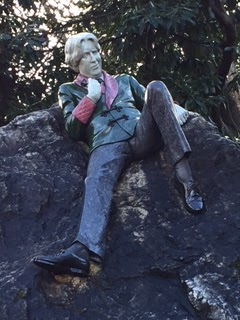

Oscar Wilde Sculpture
Dublin is a city that encourages walking and has even put together a writing trail which includes a visit to Oscar Wilde’s House, the Oscar Wilde Memorial Sculptures in the gardens opposite his childhood home off Merrion Square, as well as the James Joyce Centre and more. My good friend and writer, Rachelle Atalla, also recommended I visit Sweny’s Pharmacy, an oldie-world former pharmacy that sells second hand books and appears in Joyce’s Ulysses and where volunteers read from his work. When we visited, Ulysses was being read in French, and given my knowledge of French has gone much the same way as my handwriting, we didn’t linger long, but it was lovely to imagine we’d walked in Joyce’s footsteps, if only for a little while.
 
Sweny's Pharmacy
mentioned in Ulysses

Contemporary Female Irish Writers

 In preparation for my trip to Dublin and also since I've returned, I've been reading contemporary female Irish fiction writers. I have long been a fan of both Marian Keyes (my review of her latest release, The Break) and Cecelia Ahern (one of my Christmas reads was The Gift), but I was also lucky enough, last year, to hear the fabulous short fiction writer, Claire Keegan, give a reading at Aberdeen University (my review of Foster). Next on my to-be-read pile was The Hollow Heart by Adrienne Vaughan, editor of the Romantic Novelists’ Association magazine and author of the Heartfelt series. Vaughan’s latest The Summer at the Seahorse Hotel is out now.
Lastly, my current bedtime read is The Good Mother by Sinead Moriarty, recommended for those visiting Dublin, over on the Trip Fiction website. Ireland’s literary tradition is most definitely alive and well.

If you’re unable to sample the delights of Ireland for yourself then why not try the next best thing and read some of its brilliant fiction. I'd love if you'd join in the craic by sharing your favourites below …

Happy reading,
Rae


SaveSave

Saturday, 10 February 2018

THE ART OF WRITING A LOVE LETTER by Victoria Cornwall


This week is Valentine's Day. A day for romance, when gifts and cards are exchanged to declare one's love. For many, in this world of digital messaging, it may be one of the few times their feelings of love are expressed by the pen. The art of letter writing is fading fast and with it, dare I say, is the art of writing a love letter. Yet when a woman receives a love letter, written from the heart by the man she loves, it will mean more than any card or bunch of flowers bought on the way home from work.

Why? Because writing a love letter takes time, deep thought, is personal and unique. It opens a window to the writer's thoughts that he/she may find difficult to express in words. If written well and the feelings are returned, the recipient feels valued and connected on a deeper level than before.


Keely Chace gave her top tips for writing a love letter to him on the Hallmark website.

Make him feel it from the start.
ie My Darling …
Mention why you’re writing.
It might be an occasion like Valentine’s Day, but I just felt like telling you…is also a good reason.
Affirm him.
What do you like about him and/or what are you grateful for?
See the future.
What are you looking forward to together? Seeing him tonight? Still loving him when he’s 64?
Finish strong.
with an affectionate signing off such as All my love, Forever yours, Tenderly, Your loving wife…etc.

Her tips certainly give a template, although perhaps a love letter written from the heart is more genuine than one following a step by step guide.

What advice would a man give to a man? Tom Chiarella from Esquire says "A good love letter declares itself plainly, then illustrates particularly.... Let the example precede sentiment. .... Don't repeat yourself. Emotional declarations matter more if you make them one at a time, space them a little....Let her know that she is redefining your terms."


What elements do I think a love letter should have? For me a love letter holds more value when it is not in response to an earlier argument and therefore has no agenda. It should be written with care, thought and love, sharing heartfelt feelings of how much the recipient means to them. It should not be too long or too complicated, nor too brief.

I think we all have a love letter inside us, but perhaps not all of us are brave enough to expose our innermost feelings. If a full letter is too exposing, than perhaps a heartfelt signing off could be a good place to start. Despite leading the country in the second world war, Winston Churchill still felt able to sign his letters to his wife in the most affectionate terms.

"Sweet cat—I kiss your vision as it rises before my mind. Your dear heart throbs often in my own. God bless you darling keep you safe & sound." 

One takes a risk when penning a love letter in this day and age. Love letters, written in solitude and given in confidence, can be shared on the internet within seconds. However, whenever I read one I only think how lucky the recipient is, to have someone love them as deeply as the person who penned the letter.

"I already love in you your beauty, but I am only beginning to love in you that which is eternal and ever previous – your heart, your soul. Beauty one could get to know and fall in love with in one hour and cease to love it as speedily; but the soul one must learn to know. Believe me, nothing on earth is given without labour, even love, the most beautiful and natural of feelings." 

Leo Tolstoy to Valeria Arsenev (November, 1856)

"…I am reduced to a thing that wants Virginia. I composed a beautiful letter to you in the sleepless nightmare hours of the night, and it has all gone: I just miss you, in a quite simple desperate human way. You, .with all your undumb letters, would never write so elementary a phrase as that; perhaps you wouldn’t even feel it. And yet I believe you’ll be sensible of a little gap. But you’d clothe it in so exquisite a phrase that it should lose a little of its reality. Whereas with me it is quite stark: I miss you even more than I could have believed; and I was prepared to miss you a good deal.
So this letter is really just a squeal of pain. It is incredible how essential to me you have become. I suppose you are accustomed to people saying these things. Damn you, spoilt creature; I shan’t make you love me any more by giving myself away like this — But oh my dear, I can’t be clever and stand-offish with you: I love you too much for that. Too truly. You have no idea how stand-offish I can be with people I don’t love. I have brought it to a fine art. But you have broken down my defenses. And I don’t really resent it."

Vita Sackville-West to Virginia Woolf

A well crafted love letter is special indeed, and even more so when it is written by the one you love. Should you receive one, cherish it and revisit it, for someone has been brave enough to open their hearts to you and, more importantly, feel you are worth the risk to do so.


Author of
&


Monday, 5 February 2018

WRITING .... WHEN LIFE GETS IN THE WAY LINDA MITCHELMORE

Now then, I rarely post personal stuff in the ether ..... certainly not on Facebook or Twitter unless it's to urge people to buy my books or the magazines in which I have stories. But this blog is, I think, different - albeit in the ether as the others. Writers can't just stop being writers because life gets in the way of things like deadlines and ideas that strike in the middle of the night. But the thing is, my husband hasn't been well for some time and just before Christmas he took an alarming turn for the worse. He was unable to eat, suffered massive weight loss, and everything that goes with those things took an alarming toll on him. A visit to our GP saw him whisked to hospital, but he was too weak to undergo an operation so he was drip-fed antibiotics and tube fed nourishing things until he built up strength which, mercifully he did, and was able to have the operation he needed.
Now then, in the middle of all this worry, and twice-daily drives to the hospital and back, and hours by his bedside, my copy edits arrived from my new publisher. To mention all the above or not? I decided not. I devised a plan. I would get up uber-early (who can sleep soundly with a poorly loved one in hospital anyway?)and do the edits then. I had a week in which to do them. I did. Just. And then said publisher asked for a synopsis for my next novel, also in a week. I said that would be a push and could I have a bit longer .... I could. Phew! And then a magazine editor wanted some tweaks to a quite long short story .... contradiction in terms but writers will see that as a normal statement. Could she have it back in 48 hours .... she could and she did. Phew!
And then there was the thorny question of whether or not to take our grandchildren in to see their granddad. They spend a lot of time with us and were missing him and asking for him. Would they be upset by drips and machines buzzing at random intervals and granddad not being able to play hide and seek with them? In the event they seemed to be far more interested in the control panel at the end of granddad's bed that raised and lowered the head rest and various other things than they were in the poor old boy in it. And the free hot chocolate in the day room was pronounced far superior to anything they'd ever had in a cafe anywhere although six-year-old Emily grumbled about the lack of mini-marshmallows!
And talking of hot drinks .... a young Polish man - a patient in the bed opposite my husband's - was going into the day room to get himself a drink and stopped to ask me if he could get me tea, or coffee, or hot chocolate. And that's when another short story idea came to me. Right there in the most inappropriate of places and I did get a pang of guilt, but it's what writers do - we can't help it. I'm sure other writers will understand. P.S. My husband is now home, I'm pleased to be able to say.

Saturday, 27 January 2018

Learning for my Art...

Make sure you know your birds!
Image courtesy of Jrrobinantony via Wikipedia.
Being a writer, I’ve decided, has to be the most stimulating job there is. The research process takes you down a lot of highways and byways, some of them dark and some of them full of sunlight and pixie dust. 

They do say you should write about what you know, but sometimes characters take you places where you haven't been before. The more diverse your characters, the broader your own range of knowledge has to be. If you have a character who’s a birdwatcher, that character’s going to notice the birds around them and they’re going to recognise their songs. That means that you need to know what sort of birds they’re likely to see, where and when. So, no yellow wagtails in the deep winter of the Western Isles, please. 

I’m treading very carefully on strange ground at the moment. A main character in my work in progress has a hobby that’s alien to me: she reads the tarot cards. And that’s a steep learning curve. 

I’m lucky to have a friend who’s a tarot reader and happy to give me advice — but I can’t rely on her goodwill indefinitely. (“What card reading would give me this message?” “What set of cards would be relevant to that situation?”) That means I have to take some responsibility on myself and learn. 

I’m at a very early stage. The first thing I’ve had to do is drop all my preconceived ideas about tarot cards. They don’t tell your fortune. They offer you a reading of the situation that’s up to you to interpret. So that’s the first thing. 

The second is to learn to read the cards. I have a book, I have my friend, and I have a particularly good website — but although they all use the same cards, they give slightly different descriptions of what that card means. For example the infamous Hanged Man — Wikipedia has it as meaning “self-sacrifice more so than it does corporal punishment or criminality”, while other sources give it a  second meaning to go alongside this: that the old must give way to the new. Applying different meanings to every card (and those meanings also vary as to how the cards are laid out, but that gets very complicated) means a lot of reading and a lot of thought. 

And then, as a writer, it gets even more difficult. Laying out the cards and deciding what they say is one thing. Finding a spread of cards that gives the messages you want your characters to receive is altogether different. The only way I can see that working is to buy a set of tarot cards and try it for myself.

Saturday, 20 January 2018

WORDS OF WISDOM by the NPOV Team.


'By three methods we may learn wisdom:
First, by noble reflection, which is the noblest;
Second, by imitation, which is the easiest;
and third, by experience, which is the bitterest.'

Confucius

Every year we become a little wiser. The quote above, by Confucius, sums up succinctly how we acquire this wisdom. How much easier life would be if we had that wisdom at the very beginning of our adult life or our careers. This got me thinking. What words of wisdom would I tell my younger self?


This week, my fellow Novel Points of View contributors and I share the life lesson we would like our younger self to know at the start of our writing careers.

Although it is possible to be an overnight success as a writer, this is not the normal path for most authors. Becoming a published author can take years. Once you are published it can take many more years (and books) to become a successful, established author with a firm fan-base. If I understood the long journey ahead of me at the beginning, I would have viewed each part of the process as a step forward towards my goal and not allow the setbacks to sap my confidence. I would tell the younger Victoria -

You are not alone, the majority of authors have travelled the same long journey and those who experience overnight success with their first novel are very lucky, but not the norm.


***


Jennifer Bohnet
Things I would tell my younger self about writing? There are two quotes I recommend you print out and keep within view every time you sit down to write.

The first is from J.K.Rowling (if only she’d been around when I first started out!)


‘Perseverance is absolutely essential, not just to produce all those words,
but to survive rejection and criticism’.

Rejection is a nine letter word that hurts far more than any old four letter word when it is hurled in your direction. It knocks any self-esteem you may happen to have managed to acquire right out of the picture. Rejection happens more than anyone expects and is very hard to deal with in the beginning. You have to deal with it and move on.

The other quote is from a sign I have on my office wall:


‘You never fail until you stop trying’. That says it all really - both for writing and life.’

And while you’re Trying and not Failing remember the following and have a good life:


***


I have learnt so much on my writing journey and still have plenty to master, but the tip I wish I could pass on to my younger self would save me months of both time and heartache. It would be to

give up on perfectionism and simply get the first draft written.

To keep striving forwards, rather than refining and editing paragraphs and scenes that may not even make the final cut. To understand, and accept, that there will be time to revise and edit, once I know my characters better and have worked out where my story is going and what it’s really about.

I love collecting quotes that remind to push on. Here are a few of my favourites…

I’m writing a first draft and reminding myself I’m shovelling sand into a box so that later I can build castles
Shannon Hale

Don’t think about making art, just get it done
Andy Warhol

The worst enemy to creativity is self-doubt
Sylvia Plath


Now back to creating that first draft…


***


I wish I’d known, way back then when my dad was alive and I began to get short stories published, that I’d go on to be a novelist. My dad was ever my staunchest ally – my mother used to say: ‘The higher you ride, the further you fall’ if ever I went to her with news of a success of some sort. But dad was different. People would say to him, ‘You must be so proud of Linda’ whenever I passed an exam or won a prize but he always said, ‘No, not proud, I’m not a proud man. But I am very, very pleased for her.’ And so he was.

Before he died he read all the short stories I’d had published in national magazines to date (although no surprises that my mother never did) and when I said I wondered if I could write a novel one day he uttered his other oft-used phrase – ‘You can do it, kid.’

Well, Dad, I did but too late for you to pick up my book with my name on it and with my dedication to you for all your support. So, the crux of the tale is that if we even begin to think we might do things then we must. If only I could wind back time ....


***
If I knew then what I know now…what kind of theme is that for a blog post? It’s more the title for a 100,000 word memoir. And, let’s face it — I’m still learning, so my ninety-year old self will probably still have plenty of advice for me, if I could only hear it. 

There are so many areas that I could look at, so many things I would have done differently. But because this is a writing blog, it’s probably wisest to confine myself to writing. And although again I could subdivide this into a number of different topics, I think I’m again going to narrow it down to one. 

Writing is a craft. I didn't realise that when I was younger. I knew I could string words together and create characters who did interesting things, and I thought that was enough. It isn’t. There are conventions (not rules) in writing and they’re there because they work, either absolutely or in terms of expectations of your readers at any given point in time or any particular genre. If you don’t satisfy them, then you fall short. 

So what I would have said to my younger self is this.

Talent is only a part of it. You can’t write without it, but it isn't enough. Writing is hard, hard work — but it’s worth it.


***

Life is a journey, with many forks, twists, up and downs. Each step will teach us something about ourselves and the world around us. We can pass on the lessons we learn and seek out the experience of others, but ultimately it is a journey we have to navigate ourselves ... as no one can do it for us.

What would you like to tell your younger self?

Sunday, 14 January 2018

New Year Get Away

Glen Affric
After last years New Year trip to the North West Coast I was not best pleased when Audrey told me she had booked us up again for New Year in Clachtoll. I love exploring that area but the weather was awful the previous year  and I did not have much hope.

A week or so prior to Christmas we had a heavy snowfall and although it slowly melted away from the North East corner it continued to fall across on the West Coast.
I set off early in the morning so that I could stop off and take detours in the daylight hours. One of the detours took me to Glen Affric which is deemed as one of the most beautiful places in Scotland. Glen Affric did not disappoint, the  Caledonian Forest covered in snow was like a scene from Narnia. I have visited this area on two previous occasions however the weather had always been against me but today it was perfect.

I spent more hours than necessary travelling to Clachtoll as the lighting was superb, I simple couldn't resist stopping to snap the views.


Assynt Trees

Although the snow was confined to the higher ground the snow capped hills were breath taking. A rare occurrence  of virtually no wind meant for mirror like lochs. It was paradise and hardly another person in sight.

On the morning of the 31st December I set off to capture an image that I had previously seen posted by a photographer local to Lochinver. I had researched the area and the route to  get there, so off I set. Although there was snow on the hills the temperature was sitting above freezing and the roads were clear or so I thought. As I crested a hill I realised that road was covered in a sheet of ice, I had no option but continue. However I soon realised that I had to abandon the trip and turn the car around. Whilst doing so I ended up sliding on the ice, straddling the single track road teetering on the verge either slipping into a deep burn to the rear or heading nose first into a loch !
Fortunately there were two good Samaritans who managed to help me out of my predicament, it did however shake me up and meant that for the rest of the day I struggled to take a photo.

After a festive New Years Eve spent in the company of friends and a longer lie than anticipated on the 1st I eventually ventured out on the road again. I did however make sure that I stayed on the main roads.
Clashnessie
 I spent a few hours dodging sleet showers trying to capture Split Rock. Despite the showers the lighting again was stunning with the sun lighting up the hills beautifully. Audrey had taken a photo a number of years ago that I was aiming to emulate however I still cannot fathom how she manged to capture what she did or where she was positioned. I am however happy with my shot.
Split Rock

Sunday, 7 January 2018

It's a New Year - 2018


Welcome to the first Novel Points of View blog for 2018. The seven of us wish you all a Happy, Healthy and Prosperous New Year with lots of books in your life, whether you are a writer or a reader.


I did briefly think about writing a post about New Year resolutions but the only one I’ve made this year is to live in the moment and cherish every day. Then I thought maybe some of you have the luxury of having been given book tokens for Christmas and have yet to spend them. Because I am unable to get to writerly events like conferences or workshops, or even to a local writing group, I buy lots of writing related books. Inevitably one or two stand out as being superior to the rest and the one I treated myself to before Christmas is definitely my book of 2017.


From the blurb of ‘Into The Woods’: ‘Much more than a 'how to write' book, Into the Woods is an exploration of this fundamental structure underneath all narrative forms, from film and television to theatre and novel-writing. With astonishing detail and wisdom, John Yorke explains to us a phenomenon that, whether it is as a simple fable, or a big-budget 3D blockbuster, most of us experience almost every day of our lives.’


 Anyone who writes knows that stories have a basic shape:  beginning-middle-end. Screenwriters know story structure inside out and learning how they approach the written word is something that has definitely made me think about my approach to writing. John Yorke’s book opened my mind to things that had never before occurred to me. My current work in process is my thirteenth book (a number I still can’t quite believe) but In a very short time ‘Into The Woods’ has become my ‘bible’ I’ve learnt so much from it.
If you are serious about your writing I urge you - spend that book token (or even cash!) on this book.