Saturday, 26 March 2016

LOVING A COLOURFUL LIFE... by Rae Cowie

Crimson, buttercup, emerald, slate, cocoa bean… I’ve always been drawn to colour, in what I wear, how I decorate and especially when writing. I love the richness and joy colour brings, both visually and through words on the page. I’ve been known, when travelling, to collect paint colour charts. An unusual souvenir but they’re great reference aids when my creative mojo goes walkabout. I flick through their pages savouring exotic names that roll off the tongue - prairie peach, climbing vine, cheetah spots, young banana - soon those ideas are coursing  again.

And so I look forward to what has become an annual treat when I meet my friend, K in one of our favourite places to visit - the seaside town of Broughty Ferry, near Dundee. As well as enjoying K’s company, a hearty lunch followed by ice cream and a stroll along the beach, one of the things I most look forward to is browsing the Eduardo Alessandro Studio, which showcases Scottish contemporary art. So what has all this to do with writing?

Artwork by Jack Morrocco
Well K is a keen amateur painter who knows her stuff, introducing me to the street café scenes of Jack Morrocco, the clean lines of fine artist and children’s illustrator, Dan Crisp along with the quirky designs of Gail Stirling Robertson. When browsing alone I tend to be quite simple in taste, drawn to exhibits brightest in colour, instinctively knowing what I like and what leaves me cold - but perhaps not understanding why. And it’s the ‘why’ K helps explain as we appreciate paintings together, providing a brief lesson in art.

First, the artist must select the palette to be used for colour scheme and harmony, choosing opposites on the colour wheel, which are pleasing to the eye. It’s also important to re-use colours to unify a painting, for example, when using a certain shade of blue in the sky to use it again in the foreground. On examining canvases carefully I found this was so – noticing the soft blush of nectarine in a snow scene or vivid mauve in the swell of the sea. And it struck me the same is true for writers when considering character development. Conflict – essential to fiction writing – works best when the protagonist and their opponent are opposite in nature. When characters are too alike then writing lacks, well – a bit of colour.

Artwork by Gail Stirling Robertson
My art lesson continues. The second decision a landscape artist must make is where to place the horizon, either above or below the mid point, avoiding dead centre, which most find too harsh. And so it is with fiction writing when selecting point of view – deciding whose story should be told, which character’s voice will grab the reader best, pulling them in. Of course in writing we have the luxury of being able to tell the story from a number of viewpoints, but they must all draw the reader towards the same final scene.

Finally, K explains the skills required when using different medium in art. My friend is a water colourist, one of the most difficult forms of painting, requiring a light touch and patience, as work must dry before the artist can continue. Unlike say the bold, layered strokes of an oil painter, who enjoys more freedom to experiment, adapting their designs. Again, this made me think of the plethora of skills required when writing– the imagery of poetry, restrictive length of a short story or novella, the need for pacing in a novel. Skills at least two members of our Novel Points of View blog team have shown in spades this week. Congratulations to Lesley Cookman on publication of ‘Murder Dancing’, the 16th in the Libby Sarjeant crime series and to Gill Stewart, writing as Gillian Villiers, on publication of ‘As Time Goes By’, the 4th novella in a collection set in the Scottish Highlands.


And so back to Broughty Ferry - and after a pleasant hour in the gallery with K, I understand more of what it must be like to stand in an artist's shoes. But then isn’t that one of the things that makes a great friend? - Someone to learn from, adding colour to life.

Saturday, 19 March 2016

ROUTINES AND CHANGE.


Social media is awash with quotes - inspirational and otherwise! But one in particular jumped out at me this week. Posted by Eloisa James the New York Times bestselling author on her page, it was attributed to Norah Roberts - an inspiration all on her own.


IF YOU DON’T GO AFTER WHAT YOU WANT, YOU’LL NEVER HAVE IT. 
IF YOU DON’T ASK, THE ANSWER IS ALWAYS NO. 
IF YOU DON’T STEP FORWARD, YOU’RE ALWAYS IN THE SAME PLACE.  


Only a few lucky people end up living the lives they envisaged while at school or college. The rest of us have to go with the flow of life and simply do our best with what it throws at us. But for the majority of us, while we are generally happy with our lot, I think life does eventually, inevitably, become somewhat routine - and miles apart from the life we grew up dreaming we’d live.

By necessity routine tends to rule our everyday lives. We have bills to pay, food to buy etc.etc. so we get up, do what we have to, relax a little, watch TV and then go to bed. Repeated day by day. We know roughly how the weekday is going to pan out; what we are doing at the weekend when the time is our own if we’re lucky. Routine gives us a sense of security even though we may rail at its inevitable restrictions and say we’re stuck in a rut. 

Maybe we even dream of breaking out but lack the courage to do so. So we fail to do what the above quote urges us to do. We don’t go after what we truly want, we never ask the question that answers yes not no, and we stay in the same place because basically we are comfortable there. Change is scary.

But despite the chains of routine, no-ones life really stays the same year in year out. Change is happening around and to us all the time. Children grow up and leave home, careers change direction, babies are born, priorities change etc.etc. All these things merge into our day to day existence and we become accustomed to the changes life makes on our behalf to our basic normal routine. 

When we write a story we strive to show via the story line arc, how the characters have changed - for better or worse - from the beginning of the story to the end. We show how they dealt with the conflict in their lives and the decisions they took that changed them. In real life though we can only live our lives to the best of our ability and pray that it all works out in the end. 

I’ve printed out Norah’s quote and pinned it to the wall in front of my desk. It will serve to remind me that sometimes, like the characters in our books, I do need to find the courage to step forward to go after what I really want and not to take no for an answer. To break away from routine and embrace change.


Sunday, 13 March 2016

Funny? Don’t make me laugh by Jennifer Young

Once upon a time I found this amusing...
I remember, clear as day, the moment I realised that studying English at university had been a mistake. My tutorial group had been sent off to choose a text which we found funny and explain why. I forget which book I picked — maybe something by Jane Austen — but the moment I sat down to write I was in trouble. The second I began the analysis, whatever had made me laugh ceased to be funny.

I changed my course shortly afterwards, and even now when people ask me, shaking their heads as they do so, why I don’t like Jane Austen, I reply that I don’t like comedies of manners. Which is true, because thanks to that long-ago tutorial, I can’t see how such subtlety is funny.

Fast forward a few decades. I’m working on a plot. I have a new character — a secondary one, but no less important for that. He’s a middle aged lawyer with an interest in antiques. His love life is rewarding and complicated and he woos the ladies with more than just a handsome bearing and a healthy bank balance. He wins them with his dry wit.

And here’s the problem. In my head he’s witty. The most cynical woman can’t resist him and the most envious rival can’t suppress a smile at his sharp and observant comments. Yet when it comes to setting him on the page the wit somehow disappears. His remarks are dry. They’re clever. But they aren’t in any way funny.

How often have you heard someone repeat an anecdote, fail to raise a laugh, shrug and then sign off with that admission of defeat: you had to be there? I do it often. It’s because I have no sense of timing; it’s a rare occasion when I think of the right thing to say at the right time, rather than two days (or, worse, two minutes) later. 

Millions of people are essentially funny. Some of them are even funny when they write. Many of those write newspaper columns. Some of them write books. But they are everywhere in life and they are some of the most successfully people in terms of romance. (He makes me laugh — surely the cry of every honest heroine everywhere.)


As someone who is funny neither in the flesh nor on the page I find it impossible to imbue my characters with the wit I know they have. Am I doomed to be for ever humourless? Oh, how I hope not.

Friday, 4 March 2016

A Birthday - and How Nothing Is Wasted by Lesley Cookman


On Thursday, it was my birthday. It wasn’t a “special” birthday, but out of the blue, my eldest daughter, Louise, sent me a text saying “Would you like to go to tea at The Dorchester on your birthday?” Now, there’s a silly question.

 So, we went. We also went to a wonderful Victorian pub in Mayfair called The Audley, where we had a bottle of fizz courtesy of eldest son Miles, who had provided Lou with the money, then strolled back through Mayfair counting the blue plaques on the wall. The Dorchester greeted us with due deference and service par excellence, the waiter flirted with Louise and the head waiter presented me with an entirely unexpected birthday cake, while the pianist played Happy Birthday.


We came home in time for me to join Miles for a drink at our local, where a friend was singing. I had more fizz, and a birthday drink from the landlord, Roly, who discussed elements of the current work in progress. Research opportunities everywhere.

Now all of this is grist to the mill of a working novelist. People watching in an environment that I haven’t been in for some years is a great inspiration, and enables me to create different atmospheres for my characters – although I can’t actually imagine my Libby and her friends having tea at The Dorchester, though I could shoehorn an occasion into one of the stories, I suppose. But the best – or worst – thing about the whole day for me was the train journey home.

It was very crowded – we live on one of the busiest commuter lines in South East England, known as the worst in the country – and it lived up to its reputation. Just before we pulled into the station before our own, the driver announced: “There has been a signal failure somewhere, and we might be delayed. We will give you more information when we have it.” A few minutes later: “Please will you disembark. This train terminates here.”

It transpired that there was a train stationary at each of the seven further stations down the line, and they had been there for a minimum of forty minutes. So South Eastern Railways had had plenty of time to warn our driver and lay on buses. Had they? Had they heck! We were lucky, Louise’s partner was able to drive and pick us up, but what about the rest of the passengers? Those who had to travel on to those other seven stations? Cab? Yes, if you take out a mortgage. Compensation? Don’t make me laugh.

So, of course, the novelist starts weaving a story around some of these unfortunates. How did they get home? What happened to them? Has anybody disappeared? And where would the worried relatives inquire? Certainly not the rail company. Hugely rich and diverse field, and I’m definitely going to try and find out what happened to the real passengers – about which there is no information available so far. Poor souls – destined for the depths of a crime writer’s murky mind. Nothing is wasted.

Wednesday, 2 March 2016

Meet Simon Ward a talented photographer from Findhorn

Social media is a fantastic place and that is where myself and Simon met, having yet to meet in real world. Simon also loves the coastline of the North East of Scotland - as I do. Thanks for joining us and over to you, Simon.....

My passion for photography probably started unbeknown to me at a young age when I used to take pictures on holidays home to the Orkney Islands where most of my relatives live, with it stunning coastline and interesting history it was a fascinating place to explore and many a late summers evening was spent outside playing. 
 
 Yesnaby Castle, Mainland Orkney Isles  
I've always enjoyed the outdoors and have been lucky to live in a few beautiful places in Scotland and eventually settled in Morayshire I've always had a camera throughout my life and dipped in and out of photography but never seriously. Now though with the improvement of camera phones over the past few years I started taking more and more pictures of a beautiful place called Findhorn where we visit regularly after getting our pet dog Myles who reignited my love with the outdoors again. 

Findhorn beach at Sunrise

I'd start to seek out more and more places to walk and I continued to take more and more pictures. I got to the stage people said they were nice and I should show them which led me to join social media through Instagram which was so easy to share them with people all across the globe, I remember getting my first like and was pretty chuffed when someone commented on another picture. It was brilliant seeing other people's work and engaging with other photographers all the time feeding my own growth and techniques to being the serious amateur I am today.

 I now regularly get up at what people call ridiculous times in the morning to catch sunrises which can be around 4am in the summer but it is so rewarding to be out there by yourself seeing the changing light and peacefulness of the countryside.

Bow Fiddle Rock, Portknockie at sunrise

 I still have so much of Scotland to explore and an ever growing list of places to visit although I still love to showcase the beautiful north east of Scotland which has some of the best coastline in the country in my opinion, thanks for reading and hope you enjoyed it as writing isn't my specialty.

You can see more of Simon's stunning photography on Instagram   @SIMON_WARD_ or Facebook 
 http://on.fb.me/1TNNcZK

Saturday, 27 February 2016

MARGARET FORSTER AND ME by Gill Stewart


Margaret Forster, novelist, biographer and writer of truly memorable memoirs, died this month aged 77.


When I heard of her death, I felt I had suffered a personal loss. I felt as though she was a contemporary, a friend, who had experienced the same things I had and that now we would never be able to talk them over together. This is ridiculous in so many ways: she was my mother’s age, not mine; she was brought up in a council house in Cumbria while I was bought up in ‘nice’ private houses in Cheshire and then South Africa; she was a scholarship pupil at Oxford whereas I was a very average student at the University of Cape Town. And yet, and yet … in some strange way she was my friend, part of my family even.

My parents spent the last fifteen years of their lives in Cumbria, latterly very close to Carlisle. My mother loved the books of Hunter Davies (Forster’s husband of 56 years); my sister and I loved the books of Margaret Forster, especially her memoirs. As a family we were constantly giving each other Margaret Forster or Hunter Davies books as gifts, and conversations often contained references to them. Their lives and experiences seemed interwoven with ours.

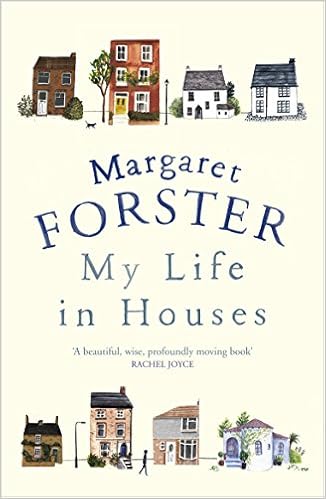
Margaret Forster was a special person: clever, talented, generous, perceptive and yet shy and unassuming. I loved her. OK, I’ve never met her, but I loved what she gave me through her writing. Her beautiful style, a sense of hope and the possibility of achievement, an ironic acceptance of her own foibles and therefore mine. I was particularly moved by her last book, My Life In Houses , in which she shares her obsessions with the houses she had lived in – and those she hadn’t. This is an obsession I have too! When she imagined living in those houses she walked passed in Carlisle it was as though she was describing me. I could completely identify. As a student in Cape Town, South Africa, I used to plan my routes home from lectures depending on which houses I wanted to dream about that day.

Margaret Forster’s writing does something that really great writing can do – it validates and enhances our own life experience, allowing us to think differently about things, giving us new meaning.

A great loss, but also how lucky we are to have ‘known’ her, even if only through her books.

Sunday, 21 February 2016

LIFE'S UNEXPECTED LITTLE PLEASURES By Linda Mitchelmore

Back in the late 1990s when I first started writing short stories and having them published, the illustration of my stories never crossed my mind. It was enough to see them in print. Back then artists were commissioned to illustrate most magazine stories and water colour seems to have been the preferred medium. Almost all my stories were illustrated and I found it flattering that an artist had read my story and painted something that illustrated it perfectly, as though he or she had got inside my head and 'seen' what I had seen when I was writing it. My Weekly were particularly good at matching artist to story. I had, back then, a wonderful working relationship with a sub-editor and was able to ask for a particular artist to work on my story. Privilege indeed! Woman's Weekly, too, are excellent at finding an illustration that gets right to the heart of a story, and I must confess I often write stories with a longer word count so that an illustration will - hopefully, but not always - be put with it, even though most illustrations these days come from an image bank.
But, Scandinavian magazines still tend to use artists and commission the illustrations. I've had many, many short stories published in Norway and Sweden, and two of my novels have been serialized in both countries. I don't know what anyone else thinks, but I find the illustrations rather old fashioned, even given my novels were historical. But it has still been a pleasure to discover an artist has read my novels and short stories in translation and produced a work of art to illustrate them.
When we write novels and have them published we expect there to be an especially commissioned book cover of some sort. These days a graphic artist will be used, and I have to say I've been very pleased with the book covers Choc Lit have commissioned for my novels and novellas. But I still have a special fondness for those first magazine stories and I have three illustrations framed and hung on the wall opposite my desk. I've recently sold three more short stories to mainstream magazines and there is a little frisson around my heart wondering what unexpected little pleasure of an illustration will be put with them.