Sunday, 29 April 2012

Making a choice

For many years I’ve worked as a journalist. I’ve been a freelance for a wide range of publications, been senior reporter on a local paper which was followed by time as a feature writer on a consumer magazine before returning to freelancing. I’ve always considered myself to be fortunate to earn my living working with words. Being downright nosy I love meeting all sorts of interesting people and being able to ask them questions about themselves, the work they do, the places they’ve been, the thoughts they think – then sharing what I’ve learned with readers. 


In between the writing for money work I’ve had poems published in a number of magazines and anthologies and published a non-fiction book and a novel. Over the last few years, though, I found I was doing less and less of what I consider to be ‘my’ writing and I hoped the move back to freelancing would free up more time for the poems, novels and the biography I want to write. Of course, it did no such thing. Being a freelance means never saying no to any work which is offered because there is always the fear it might not be offered again. Turn down one commission and it’s the person who accepted it who gets offered the next one.

There are also the relentless deadlines to meet and the pressure to be creative when I had a couple of free days. However pretentious and arty-farty it sounds, I have learned I cannot switch overnight from writing up an interview or a news story to working on a novel or short story. Maybe if I worked at something totally different – stacking supermarket shelves or typing in an office it would be easier for my brain to make the switch to creative writing? I have managed – just – to keep writing poems and my first full collection, Thousands Pass Here Every Day, will be published by Indigo Dreams in August. The biography I want to write, though, still needs further research before I can write it and the research needs fairly large block of time – time which, as a freelance (or staff) journalist I can never find.

A few months ago the Dumfries Writers’ Group invited Michael Malone to do a workshop with us. Part of it included taking a look at what we wanted to do in our writing lives and what was preventing us from achieving it. Well, I knew I wanted to continue the research for the biography I want to write and knew I wanted to write enough of the introduction and early chapters to be able to send it out to publishers. I also knew I didn’t have enough time. No matter how much I tried to manage my working life I still came up with an insurmountable time barrier. I have felt guilty about not somehow finding the time – lots of people hold down full time jobs, bring up families and find time to write, so why can’t I?

Michael’s session had been useful in clarifying my writing goals and I thought perhaps I could juggle work stuff around, use family holiday time to do some of the research, but it wasn’t really going to change very much. I was still going to drive friends up the wall by talking about a project which was going nowhere. Then Michael said something about us each having to make choices if we want to achieve our goals. It was one of those light bulb moments – and an extremely scary one at that.

I could choose not to be a journalist to give me the time I need for the biography. I thought about the implications for a while – loss of income, loss of a large part of my identity, learning to say no to commissions, missing out on meeting fascinating people – but I think I had already made the choice. So, once I have cleared my desk of the last few commitments I still need to honour I am, finally, going to get on with the research and writing of the biography. Wish me luck – and watch this space.

Sunday, 22 April 2012

Of life and death, friends and family


It was my birthday on Friday. I've got to the age when birthdays are questionable things to celebrate, but then again, each one really does become a matter for celebration simply because you're still around to celebrate it. Sadly, I have a close friend who is living her last days on this planet, and being with her and thinking about her sure heightens my appreciation of life and sharpens my awareness of mortality.

But I'm pleased to say that I had a wonderful day with friends and family. Food, wine, shared stories and a great deal of laughter, these are the things that are precious. I'm blessed with my own family, I have a wonderful husband who makes me laugh every day and who has taught me to understand how giving to others is a gift to yourself also. I have a son whose positive traits I take absolute credit for (he has no negative ones! - except, his wife tells me, a tendency to OCD, which I have to take the blame for...), and a delightful daughter-in-law whose bright, bubbly personality brings sunshine to all our lives. And I have a bunch of friends whose company cheers me and whose support I know I can count on if times get tough.

So Friday was a day of thinking about all these things. Life, death, love, friends, families - they are all the stuff of novels. In novels, throw a bomb into the middle of any permutation of that mix and you get the kind of drama starting to play out that provides the conflict needed for a story that grips. As novelists we have to think ourselves into situations that – please God - we will never have to experience ourselves. That's where our imagination comes in. But we also have to draw on our own experiences in order to enrich what we write. One day, of course, I will have to walk the road my friend Jan is walking right now - but when I do, I hope I will do it with the spirit and courage and grace she is showing all of us.

In the meantime - sorry Jan! - expect to see a character, sometime, inspired by her masterclass, because for novelists no experience is ever wasted.

Joanna Trollope claims that older writers make better writers, because of the greater breadth and depth of experience they have to draw on. That's why I'm celebrating the marking of another year.


Saturday, 14 April 2012

DON'T FORGET THE PLOT

Don’t Forget The Plot may seem like an odd thing to say to a novelist, because surely a novel is all about plot? Even novels which are strong on character or location still have to have a plot to hang this around.

And that’s true. But the problem for me is I can get so caught up in character and relationships, the conversations and thoughts that people have, the places they are in, that I all too easily find I’ve veered away from my original concept of the plot. Sometimes this is fine, the characters are finding their voices and changing things for the better, but sometimes I have to admit that, sadly, I’m just being self-indulgent. The story is wandering all over the place and readers are going to lose patience.

The reader is reading the story because they want to know where the story goes – and it definitely must GO somewhere. Likeable characters, wonderful locations, funny jokes – these are all very well and can add massively to the quality, but without the story you won’t sell your book and you won’t get readers to read it. So I think it’s worth saying again – don’t forget the plot!

To help myself, I’ve started to try to keep the following questions in mind as I write:

· Is this scene essential to the plot? If not, lose it.

· Is what is happening now interesting to the reader? More interesting than what happened in the last scene? If not, lose it.

· Do the main character’s actions in this scene bring them closer to achieving their overall goal(s)? If so, keep it.

· Is there conflict in this scene that will make it harder for my characters to achieve their goal(s)? If so, keep it.

Other things to bear in mind – the characters(s) must have a goal, but mustn’t realise it too soon or achieve it too easily. Conflict is good.

Because I write ‘into the mist’, i.e. I don’t map out my plot in great detail in advance, it is all the easier to get way-laid by non-essential scenes along the way. Sometimes these are useful as they help me to get to know my characters better or indicate a new sub-plot, but they rarely end up in the final draft, and so to a large extent are a waste of time and effort.

Ideally I would write a detailed synopsis, have all my plot worked out, and stick to it. Then I wouldn’t have to keep reminding myself about plot, would I? Unfortunately I just can’t do that. I’ve tried. The problem is, once I’ve written that really detailed synopsis, my brain somehow disengages, it feels it’s finished with that story and wants to move on. And then I can’t write that story at all, no matter how much plot it has.

So I have to write the way I write. I find when too many of the non-essential scenes start building up, I have to pause and go back and read what I have written to date. And, usually, (magically) the plot ‘arc’ shows itself to me, hidden amongst all these non-essentials. Then I tidy up what I’ve written and can race on ahead – until the next distraction.

I’m hoping to suffer from fewer of these distractions if I keep these words in front of me – Don’t Forget The Plot!

Sunday, 8 April 2012

LINDA PONDERS HEROES


I don't know about anyone else but when I'm writing a new hero I do need a 'visual' as I call it. Often I will tear a picture out of one of the Sunday glossies - I've even been known to use a model from the Cotton Traders catalogue. I pin said picture up on the wall to one side of my computer screen and then Jack/Henry/Bill is always there so I don't forget his eye colour or the way his hair flops, or his sexy smile.
However, when I was creating my hero, Seth, for my debut novel, TO TURN FULL CIRCLE, I couldn't find a face (or indeed a body) to flesh out the character I was creating. I knew I wanted Seth to be tall, to have moral strength rather than the bus-pulling variety. Although I have always been drawn to fair-haired men (preferably with brown eyes - fab combo!) - and curly hair will always do it for me in real life - I knew I didn't want Seth to be a curly-haired blond.
And then I saw him - my Seth! He walked into a moorland pub where I was having lunch with my husband. It was November - and okay, it was a warmish and sunny day - and this guy came in wearing shorts. Walking boots, binos slung around his neck, lumberjack-style check shirt, possibly lined - I didn't ask! He was a tall man with a large frame to go with it, although without a spare ounce of flesh on him. His hair was crow black and thick. I was inches away from asking if I could take his photo .....but divorce for me would have loomed if I had, I think. He was with friends - about four of them - all men. Now, I'm not saying I fancied the shorts off this guy - I didn't. But when I noticed how attentive he was when others in his party were speaking, and how easily he laughed at their jokes, I knew I'd found my hero.
TO TURN FULL CIRCLE is the first in a trilogy, so Seth will be with me for a while yet.
In the meantime I'm working on a novella - I have my hero's character, I have his height, I have his hobbies and his educational background.....all I need now is a face.
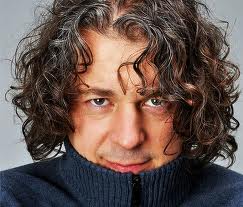
Curly-haired this time I think.....and because I think the world can never have enough pictures of Alan Davies' curly mop here he is ....just in case anyone else is looking for a face to fit their hero.

Friday, 30 March 2012


Special Offer

Fairlyden by Gwen Kirkwood

     Download for free from Amazon

1st and 2nd April 2012


Making Waves when writing a novel

Recently I have been reading through a novel which I wrote twenty years ago. I had it scanned by Lynn Anderson to make sure I was formatting the final copy as it appeared when published, prior to uploading to Amazon as an e-book. I am dismayed at the number of exclamation marks and hyphens I used then and I have deleted several. I find it difficult to judge my own work, but apart from the superfluous punctuation, I still like this story as well as many I have written since, and better than some which were limited by the publisher’s stipulation of word length.

When I wrote Fairlyden I had stumbled my way through four short romance novels for the Hale Rainbow Romance Series. Then Amstrad computers arrived, a great benefit to a none typist, and I yearned to write a longer novel. I had no publisher, no agent and no deadlines or guidelines, and I didn’t know any other writers. Remember there was no internet. I had not heard of the RNA and in any case they did not hold annual Conferences in various parts of the country as they do now. I began to write the kind of story I liked to read, set in 1850 but using the only background I knew much about – farming. It took a long time but it gave me a great deal of satisfaction, even though I had no idea whether anyone would ever read it. In retrospect I believe I could have ended it about three quarters of the way through but even then I wanted to continue the story of the family I had created.

Using the Writers’ and Artists’ Year Book I selected an agency at random. The person who replied said it was a good story but needed a lot of work and they did not have time to take it on. I chose another single person agency (for her Scottish name). She did not do editing but she read it and sent it to a publisher. Lady Luck was at my side. They wanted to buy it and sent me a contract for it and the three follow on novels which were still in my head. Most publishers like to know a writer has more than one book to build on. The editor then sent me three pages of questions, comments and suggestions – one of which I have found invaluable. Apparently readers do not like to be confronted with pages of closely written text so wherever I had long passages I was advised to convert it to speech or break it up in some other way, giving more white space; this looks less daunting to the reader. I also discovered speech moves the story along faster.

Many years later I attended a talk on writing. The speaker said writers should create waves in a novel to keep the reader’s interest. Reading Fairlyden now I realise I subconsciously created a tsunami, plus a storm or two. I can scarcely believe I created such nasty characters, or some of the sad scenes, but hopefully I have enough happy scenes to compensate and uplift. I am still learning something new with every book I write.

If any of you have a Kindle and feel like reading this story please remember you can download it for free on 1st and 2nd of April 2012. I shall be interested to hear if you feel it is too stormy, or if I should have ended it earlier. You can read the blurb for it on Amazon or on my personal blog at gwenkirkwood.blogspot.co.uk.

Saturday, 24 March 2012

Too much going on - no time to think

by Mary Smith

Over the last couple of weeks I have found my thoughts turning repeatedly to Gill’s last blog asking if we give ourselves time to think and wishing I could indeed add contemplation time to my ‘to do’ list.

I’ve certainly been doing a lot of thinking but not the kind to which she was referring. It’s been a hectic few weeks – husband in and out of hospital like a yoyo (on the road to recovery now, we think), trying to get some articles written up ahead of deadline, interviewing people – and being interviewed – and getting 21-year-old off to Nepal. The airline went bust a few days before he was due to go but the travel agent didn’t think to tell us. When we made enquiries we were told it hadn’t completely gone bust and he could still get the flight to Delhi, where he would be stranded. Managed to book him on another – much more expensive – flight and have checked he boarded the bus to London with passport, ticket, dollars, bank card, photos for visa which he has to apply for on arrival as he didn’t have time to apply before leaving because he had put his passport in the washing machine and didn’t put in for a replacement….He’s a student.

So, there has certainly been no ‘me’ time, or contemplation time. On the other hand, part of me knows I’m storing away all sorts of potentially useful material for future writing projects – conversations from hospital trolleys or how to survive motherhood, perhaps. 

Sara Bain, arts and entertainment editor for the Dumfries & Galloway Standard, has begun a series of interviews with writers. I was delighted when she asked if I’d be willing to be interviewed and she certainly made me think hard to answer her questions. 

Heard from my publisher, Indigo Dreams, my non-fiction book on Afghanistan will be coming out in July and my poetry collection, Thousands Pass Here every Day, will be published in August. So now, I have to start planning book launches and publicity and marketing – more thinking but not in a contemplative way.

I have been accepted as part of a group of artists and craft makers going on a ‘learning journey’ in April to Slovakia to visit its biosphere reserve and dark sky park. It is part of the Gallowayand Southern Ayrshire Biosphere Reserve Project and we are expected to create a record of our journey when we return. Having seen the height of the mountains we’ll be climbing – not called the High Tatras for nothing – I think I need to launch a fitness and stamina programme before I go.

Maybe stomping up and down Dumfries & Galloway’s hills over the next few weeks will give me time to think? And, after Slovakia, surely there will be time to write?

Saturday, 17 March 2012

Be prepared – Be optimistic

Only a week to go, then the clocks change and spirits will lift. Actually, it's been a funny year so far – no winter to speak of (I've only scraped frost off the car once – compared with the last two winters, this is positively tropical!), and a three-week spell in the States where we managed to find some real sunshine.

So I've no excuse at all for feeling down – and compared with a number of friends who are going through family traumas, business downturns and health problems, I really do have no excuse for feeling low. If only I hadn't chosen writing as a post-retirement career! Hitting the right place in a falling market is a real challenge. We're all being told, time and again, that book sales are dramatically down, and it does seem that publishers are fighting shy of taking on new names. However, I've got a number of friends who have been picked up recently (including our very own Linda Mitchelmore – hooray!) and I have a feeling the picture is not as clear as it might seem.

The hidden data centres round sales of e-books and the secrecy with which Amazon in particular seems to cloak sales figures. 'E-books are skewing the book ratings,' writes Jojo Moyes in The Telegraph http://www.telegraph.co.uk/culture/books/9138908/How-e-books-made-reading-sexy-again.html. The problem is that while hardback and paperback sales figures are collated and charted, only the author and publisher know the number of sales of e-books. Amazon now releases a chart of top sellers – but not numbers. For writers of 'women's fiction' in particular, this poses a problem. Many writers are reporting excellent e-book sales, but they are not necessarily being reflected in the bookstores.

Last year, sales of e-books apparently rose by 500 per cent, and are expected to increase by a similar amount this year, with digital sales expected to overtake print for the first time in the UK. We really are in the middle of a revolution.

I don't believe that people are reading less than they used to. In fact, I think the opposite may be true. And there's a terrific article on the Bookseller blog about the role of authors (a forgotten breed of professionals) – see http://www.thebookseller.com/blogs/agents-manifesto.html

So for all my friends who are still trying to break in to the market, I would say: Keep writing. Be Prepared. Be in the right place when the revolution settles.

And be happy – Spring is here and the long days are coming!